
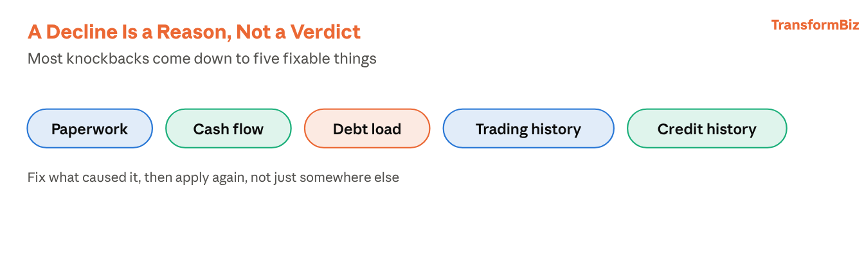
A decline is information, not a final answer. Most business loan knockbacks trace back to one of a handful of fixable causes, and what you do in the days after matters more than which bank you try next.
Why Do Banks Actually Decline Business Loans?
The most common reasons are incomplete paperwork, weak cash flow, existing debt utilisation above around 30%, limited trading history of under six to twelve months, and a poor credit history from late payments or past bankruptcy. Most lenders expect bank statements, an ATO tax portal report, business registration documents, a business plan with cash flow projections, and financial statements, with extra documents for trusts or self-managed super funds.
What Should You Do in the First Week After a Decline?
Ask the lender specifically why you were declined rather than assuming. Gather every document on a full checklist, and check each one carefully before doing anything else. Jumping straight to another lender without understanding the actual reason usually just produces a second decline.
Should You Reapply to the Same Bank, or Go Elsewhere?
That depends on why you were declined. A documentation gap can often be fixed and resubmitted to the same lender quickly. A structural issue, such as thin trading history or high existing debt, usually needs time to fix regardless of which lender you approach next, so changing lenders alone won't solve it.
What Does a Stronger Second Application Actually Look Like?
It has every required document ready upfront, a debt utilisation rate brought back under around 30%, and a cash flow story backed by a clear business plan, rather than the same application resubmitted with nothing changed.
Factor
First application
After fixes
Missing documents
BAS and latest tax return missing
Full document set, including ATO tax portal report
Debt utilisation
45%
28%, after paying down a credit card and a car loan
Trading history
7 months
14 months, reapplied after building more history
Outcome
Declined
Approved
When Should You Bring in a Broker or Adviser?
As soon as the reason for the decline isn't purely a missing document. A broker who knows which lenders on their panel are more flexible on trading history or existing debt can save you several more declines before you find the right fit, and can flag fees and terms you might otherwise miss.
What Should You Check Before You Apply Again?
- Confirm you understand the specific reason for the decline, in writing if possible
- Check that lender's criteria against your current numbers rather than guessing
- Make sure you can cover any establishment, application or ongoing fees within the loan term
- If trading history is the issue, consider start-up loans, private investors or eligible government funding in the meantime
Should You Ask the Bank Why You Were Declined?
Yes, and it's worth asking directly and in writing if the initial conversation doesn't give you a clear answer. Lenders aren't always required to give a detailed reason, but most relationship managers or brokers will explain the general driver if asked, whether that's serviceability, credit history, security, or something specific to the application (incomplete documentation, inconsistent figures). Knowing the actual reason matters because it determines whether reapplying soon with the same lender makes sense, whether you need time to fix something first, or whether a different lender with different risk appetite is simply a better fit regardless of what you do differently.
If the decline was based on credit file information, you're entitled to request a free copy of your credit report from Equifax, illion or Experian to see exactly what the lender saw, which can reveal an error worth disputing (an incorrectly listed default, a debt that's actually been paid) rather than a genuine underlying issue.
How Long Should You Wait Before Reapplying?
There's no fixed rule, but reapplying to the same lender within weeks, without having addressed the actual reason for the decline, rarely produces a different outcome and adds another credit enquiry to your file, which itself can weigh slightly against serviceability assessments if enquiries build up. A more useful approach is to treat the decline as diagnostic: identify the specific issue, give yourself a realistic amount of time to address it (which might be a few months to improve cash flow trends, or longer if the issue is a credit default that needs to age or be resolved), and then reapply with evidence the underlying issue has genuinely changed, not just that time has passed.
If the decline was about fit rather than fixable substance (the lender simply doesn't lend to your industry, or your deal doesn't match their risk appetite at any price), there's no benefit in waiting at all. The better move is applying to a different lender immediately, which is one of the clearest cases for using a broker who already knows which lenders are a realistic fit.
What Changes Actually Improve a Second Application?
Generic advice to "improve your financials" isn't very actionable, so it helps to be specific about what lenders respond to. If serviceability was the issue, a demonstrated trend of improving revenue or margin over two to three consecutive reporting periods carries more weight than a single good month, and reducing other existing debt commitments before reapplying directly improves the numbers a lender assesses. If it was bank statement conduct, three to six months of clean trading activity, without the dishonours or erratic cash flow that triggered the first concern, materially changes the picture. If it was a documentation gap (missing financials, unclear ownership structure, incomplete explanation of a figure), simply providing complete, well-organised documentation the second time around removes an objection that had nothing to do with the underlying business.
When Should You Use a Broker Instead of Going Direct?
A commercial finance broker earns their value most clearly in exactly this situation: after a decline, when you need to understand which lenders are actually likely to say yes rather than applying serially and collecting more declines (and more credit enquiries) along the way. A good broker already knows, lender by lender, which ones are flexible on the specific issue you're facing, whether that's a thin trading history, a past default, or an unconventional income structure, and can package the application to address that lender's specific concerns upfront rather than you finding out the hard way after submission.
Brokers are paid by the lender on settlement in most commercial lending scenarios, not by you directly, though it's worth confirming the fee structure with any broker before engaging them, since terms do vary by broker and deal type.
Does a Decline Show Up on Your Credit File and Affect Future Applications?
The decline decision itself isn't recorded as a negative mark, but the credit enquiry generated by the application is, and it stays visible on your file for five years. A single enquiry has a minor, usually negligible effect, but several enquiries in a short period, which is exactly what happens if you apply to multiple lenders in quick succession after a decline, can itself become a factor the next lender weighs, since a cluster of recent enquiries can read as a sign of financial stress even when the underlying cause was simply shopping around.
This is a practical reason to be deliberate rather than scattershot about where you apply next, favouring a smaller number of well-targeted applications (ideally guided by a broker who can assess fit before submitting) over applying broadly and hoping one lender says yes.
What If the Decline Was Specifically About the Industry You're In?
Some industries face more conservative lending policies across the board, regardless of how strong an individual business's financials are, because lenders set sector-wide risk appetite based on historical default rates and perceived volatility in that industry (hospitality, some retail categories, and certain import-reliant businesses are common examples). If your decline was industry-driven rather than business-specific, improving your own financials won't necessarily change the outcome with that lender, because the policy constraint sits above the individual application.
In this situation, the more productive path is usually identifying which lenders, often non-bank or specialist commercial lenders, don't carry the same blanket industry caution, rather than spending time improving metrics a conservative lender won't reconsider regardless. A broker with current knowledge of which lenders are actively writing loans in your specific industry right now is particularly valuable here, since lender appetite by industry shifts over time with broader economic conditions.
Is It Worth Improving Your Position Before Any Application Rather Than Reacting to a Decline?
The scenarios above are all framed as responses to a decline that's already happened, but the more comfortable position is addressing serviceability, conduct and documentation gaps before you ever apply, rather than learning about them through a knockback. If you know finance is coming in the next six to twelve months, whether for growth, an acquisition, or equipment, a proactive conversation with a broker well before you need to apply often surfaces the same issues a decline would reveal, but with time to address them calmly rather than under the pressure of a deal or opportunity with a deadline attached.
What's the Single Most Common Reason Businesses Get Declined Twice?
Reapplying to a different lender without actually changing anything about the application itself, on the assumption that a different decision-maker will simply see things differently. Occasionally that works, particularly if the first decline really was about fit rather than substance, but more often a second decline follows the first for the same underlying reason, just confirmed by a different lender. Treating each decline as genuine feedback to act on, rather than a result to shop around past, is consistently what separates a quick second approval from a longer run of repeated knockbacks.
Disclaimer
This article is general information only and does not take into account your personal or business circumstances. Lender criteria vary and change over time. Speak with TransformBiz's advisory team before reapplying for finance.
Sources:

Written by
Vineet, Founder & Principal Advisor
Founder of TransformBiz with 20+ years across PwC, Deloitte and Protiviti in corporate finance, banking and operations.