
Most business owners who fall behind on a BAS or income tax bill assume there is one standard arrangement, take it or leave it. That is not how it works. The ATO offers a genuine range of payment plan terms, and in some cases a fully interest-free arrangement, but only if you engage before the debt forces the ATO's hand. Sitting on it and hoping it resolves itself is the one option that is guaranteed to cost you the most.
Why Doing Nothing Is the Expensive Option
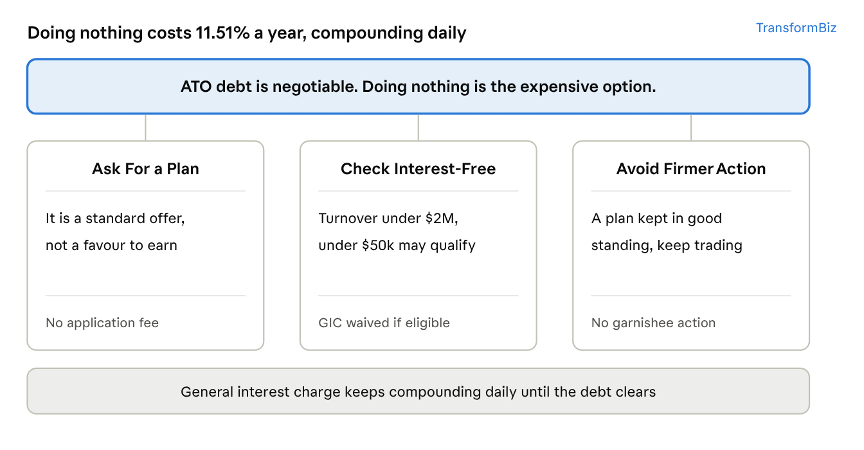
Unpaid tax debt accrues the General Interest Charge (GIC), which compounds daily and currently sits at 11.51% per annum for the October to December 2026 quarter. Since 1 July 2025, GIC is no longer tax deductible, so every dollar of it is a real, after-tax cost to the business, not something a higher marginal tax rate used to soften. Left untouched, a $100,000 balance adds roughly $12,200 in interest over a year, and that is before any penalties for late lodgment.
Is a Payment Plan a Favour, or a Standard Option?
It is standard. The ATO sets up payment plans as a routine part of debt collection, not an exception granted to businesses it likes. You can apply through Online services for business or through a registered tax agent, and for many debts under a threshold it can be set up without ever speaking to a person. What businesses miss is that the terms inside that process are genuinely negotiable: how much you pay upfront, whether it runs weekly, fortnightly or monthly, and how many instalments you take to clear it.
Can a Small Business Get an Interest-Free Plan?
Yes, within limits. Eligible small businesses with turnover under $2 million, activity statement debt of $50,000 or less that has been overdue for up to 12 months, and a reasonable lodgment and payment history, may qualify for a plan where the GIC itself is remitted for as long as the plan stays on track. This is specifically for activity statement (BAS) debt, not every tax liability, and it has to be requested, it is not applied automatically.
What Happens If You Ignore the Debt Instead?
The ATO's compliance approach escalates in stages, not all at once. A business that goes quiet typically sees firmer collection action over time, including director penalty notices that can make company tax debt personally payable by directors, garnishee notices against business bank accounts, and in serious cases, legal recovery action or statutory demands. A payment plan that is kept in good standing avoids all of this, the ATO's own guidance is explicit that engaging proactively keeps options open that silence closes off.
What If You Cannot Meet the Repayments the ATO First Proposes?
Say so before you default, not after. A payment plan can be varied, and the ATO has shown a more flexible approach to GIC remission in cases of genuine hardship separate from ordinary cash flow pressure, such as a specific cost shock to the business. A plan that is realistic and kept to is worth far more than an aggressive one you cannot sustain and that lapses within a few months.
What Information Does the ATO Actually Want From You?
Setting up a plan through Online services for business requires surprisingly little beyond your own numbers: the outstanding balance, your proposed payment frequency, and how long you need. You do not need to submit a business case or justify why you fell behind for a standard plan. The interest-free small business plan is different, you will need to demonstrate turnover under $2 million and show the debt meets the age and size thresholds, which the ATO can usually verify from your own lodged returns and activity statements rather than requiring separate paperwork from you. What trips businesses up is proposing a plan they cannot actually sustain just to get the ATO off the phone, rather than a realistic one based on actual cash flow. A plan that defaults within a few months puts you back where you started, now with a broken payment history working against any future negotiation.
What Happens If You Default on an Existing Payment Plan?
A single missed instalment does not usually trigger immediate escalation, the ATO's systems typically allow some flexibility for a one-off issue if you contact them before or shortly after the missed payment. Repeated defaults are a different matter. Once a plan has failed more than once, the ATO is less likely to offer another one on the same terms, and the business's broader compliance history starts affecting other dealings with the ATO, including how closely future returns are scrutinised.
If you can see a default coming before it happens, the ATO's own guidance is to contact them proactively rather than wait for the automated reminder. A plan that is varied in advance of a missed payment is treated very differently to a plan that lapses silently and then needs to be renegotiated from a weaker position, with a worse compliance history attached to the business. Does a Director Become Personally Liable for Company Tax Debt?
Potentially, through a Director Penalty Notice (DPN). The ATO can issue a DPN making a director personally liable for certain unpaid company tax debts, chiefly PAYG withholding, GST, and superannuation guarantee charge, when the company fails to lodge or pay on time. This is one of the sharper edges of ignoring ATO debt rather than engaging with a plan, because it moves the exposure from the company's balance sheet to the director's personal one.
There are defences, including that the director took all reasonable steps to ensure compliance, or that the debt relates to a period before they became a director, but these are genuinely difficult to establish after the fact. A payment plan that is current and in good standing is one of the clearest ways to avoid DPN exposure altogether, because the debt that triggers a DPN is specifically debt that remains unpaid and unlodged, not debt that is being actively managed under an agreed arrangement.
Is It Better to Use a Tax Agent or Deal With the ATO Directly? Either works for a straightforward plan request, but a registered tax agent earns their fee when the situation is more complicated, multiple debts across different tax types, a prior default, or a genuine hardship argument that needs to be framed correctly to be taken seriously. Agents also deal with the ATO's systems daily and have a better sense of what a realistic, approvable proposal looks like, which matters if your first proposal is likely to be rejected as unrealistic.
For a business with a single, straightforward BAS debt and no history of default, doing it yourself through Online services for business is usually fine. For anything with director penalty exposure, multiple entities, or a request for GIC remission beyond the standard small business concession, bring in a tax agent or your accountant before you approach the ATO, not after a first attempt has already gone badly.
What If the Debt Has Already Gone to External Debt Collection?
If the ATO has engaged an external collection agency or progressed to legal recovery, a standard online payment plan application may no longer be available, and you will usually need to deal directly with the ATO or the collection agency to negotiate terms. This does not mean the options described above disappear entirely, a negotiated arrangement is often still possible, but the leverage has shifted and the ATO is less likely to offer the more flexible, self-service terms available earlier in the process.
The practical lesson is timing. Every stage this situation is allowed to progress through, from a quiet overdue balance to active collection action, narrows your options and increases the pressure to agree to less favourable terms just to stop the escalation. Engaging at the first sign of a cash flow problem, rather than after the ATO has already escalated, keeps considerably more of the standard options on the table.
Will a Payment Plan Affect My Credit Score or Credit File?
An ATO payment plan itself is not automatically reported to credit reporting bodies the way a default on a commercial loan would be. However, unpaid tax debt above $100,000 that meets certain disclosure criteria can, in some circumstances, be reported to credit reporting bureaus under the ATO's disclosure of business tax debt rules, which is a separate mechanism from the payment plan itself. Businesses with debt approaching that threshold should treat engaging with a plan as something that also protects their credit standing, not just their cash flow, since a disclosed tax debt can affect the business's ability to raise finance elsewhere.
Frequently Asked Questions
Is an ATO payment plan the same offer for every business?
No. The structure is standard, but the actual terms, how much upfront, how many instalments, and whether GIC is charged, depend on your turnover, the size and age of the debt, and your lodgment history. Eligible small businesses can access an interest-free plan that is not available to larger or less compliant businesses.
What is the current ATO General Interest Charge rate?
The GIC rate for the October to December 2026 quarter is 11.51% per annum, compounding daily. It is set quarterly and is no longer tax deductible as of 1 July 2025.
Can the ATO actually waive the interest on my debt?
In limited circumstances. The ATO can remit GIC and penalties under the Taxation Administration Act 1953 where it is fair and reasonable to do so, typically where the delay was caused by something outside the business's control rather than ordinary cash flow difficulty.
What happens if I just stop responding to the ATO about my debt?
Collection action escalates over time rather than happening all at once, and can include director penalty notices, garnishee notices against business accounts, and legal recovery action. Engaging early and setting up a plan avoids this escalation.
Can a director be personally liable for a company's ATO debt?
Yes, through a Director Penalty Notice covering PAYG withholding, GST, and superannuation guarantee charge that remains unpaid and unlodged. A current payment plan in good standing is one of the clearest ways to avoid this exposure. What happens if I miss a payment on an existing ATO plan?
A single missed payment usually has some flexibility if you contact the ATO promptly, but repeated defaults make future plans harder to get and affect the business's broader compliance standing. Sources

Written by
Vineet, Founder & Principal Advisor
Founder of TransformBiz with 20+ years across PwC, Deloitte and Protiviti in corporate finance, banking and operations.
Try it yourself
Deal Analysis Engine
Price a business you want to buy or sell — or health-check your own — with the same underwriting lens we use on real deals.