
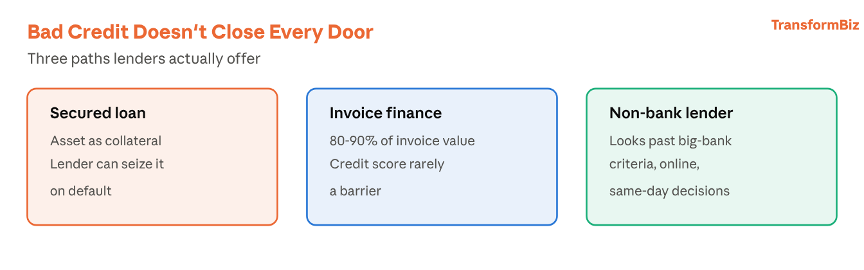
Often, yes, though not on the same terms a clean credit file would get you. A weak credit history closes off the cheapest mainstream lending, but it doesn't close off finance altogether. Three paths tend to stay open regardless of what your file says.
What Actually Counts as "Bad Credit" for a Lender?
Payment defaults, court judgements and overdue accounts listed as credit infringements all lower a business's credit score. Services such as CreditorWatch's RiskScore run from 0 to 850, and a rating in the impaired or default tiers signals high risk to most lenders. Major banks apply strict criteria against scores like this, though some lenders look at the business's broader financial position and the directors' personal credit as well.
What Are Your Three Main Options?
Broadly, a secured loan backed by an asset such as property, invoice finance against unpaid customer invoices, or a non-bank lender willing to look past a major bank's strict criteria.
How Does a Secured Loan Work Here?
You offer an asset, usually property, as collateral, which makes the loan less risky for the lender even against a weaker credit history. A clear business plan and financial forecasts showing you can meet repayments help the case, but the lender can seize the asset if you default, so this isn't a decision to take lightly.
How Does Invoice Finance Work Here?
You sell some or all of your unpaid customer invoices to a factoring company, which takes over collecting them, and you typically receive about 80 to 90% of the invoice value upfront minus fees. Bad credit generally isn't a barrier here, but funding is capped by your invoice value, so it may not cover a large lump sum need.
What Do Non-Bank Lenders Actually Offer?
Non-bank lenders don't hold a banking licence, so they can't take deposits, but they're still bound by ACCC and ASIC rules and are often funded by major institutions behind the scenes. They may approve applicants who don't meet big-bank criteria, process applications online with same-day decisions, and sometimes offer unsecured loans. Even so, very poor credit may still miss out on their most competitive rates.
Indicative risk tier
What it generally means
Low risk
Most mainstream lenders, including major banks, at standard rates
Moderate risk
Mainstream lenders with conditions, or non-bank lenders at standard rates
High risk (impaired)
Non-bank or secured lending more likely than a major bank
Very high risk (default)
Secured lending or invoice finance more realistic than an unsecured loan
These tiers are indicative, not a published scorecard from any one lender. Where a specific business actually sits depends on the credit provider and its own policy.
What Should You Check Before You Sign Anything?
- Be wary of any offer promising guaranteed approval or no credit check. Australian regulation requires credit checks for all credit products
- Confirm whether the loan is secured, and exactly what happens if you default
- Check whether a non-bank lender is covered by the Financial Claims Scheme the way a bank deposit would be, since most are not
- Compare the total cost of invoice finance fees against a secured loan's interest before assuming it's the cheaper option
How Long Do Defaults Stay on Your Credit File?
Under Australia's credit reporting rules, most defaults remain on your credit file for five years from the date they're listed, regardless of whether you later pay the debt off. Paying out a default doesn't remove it from your file, but it does update its status to show as paid or settled, which most lenders view meaningfully more favourably than an unpaid default of the same age, even though both remain visible for the same period.
Serious credit infringements (where a credit provider believes you committed fraud or provided false information) can stay listed for seven years, and bankruptcy remains on the National Personal Insolvency Index permanently, though it only shows on your credit file for a defined period (generally five years from the date of bankruptcy, or two years from its end, whichever is later). Knowing these timeframes helps you plan realistically: a default from eighteen months ago with a clean file since is a very different story to lenders than one from six months ago, even if the dollar amount was identical.
What's the Difference Between a Default and a Court Judgment?
These are often confused but carry different weight with lenders. A default is listed by a credit provider directly, for amounts typically over $150, once a payment is overdue by 60 days or more and the provider has made reasonable attempts to collect it. A court judgment is a different, generally more serious listing: it means a creditor took legal action and a court formally ordered you to pay a debt, which signals the creditor considered the matter significant enough to escalate beyond standard collection processes.
Lenders generally view a court judgment more cautiously than a simple default of similar size, both because of what it suggests about how the debt was handled and because an unsatisfied judgment can sometimes support further legal enforcement action against your assets. If you have a judgment rather than a standard default, it's worth getting specific advice on whether it can be set aside, satisfied, or otherwise resolved before it materially affects a finance application, since the path to addressing a judgment differs from simply paying out a standard default.
Can You Get a Mainstream Bank Loan With a Default?
It depends heavily on the default's size, age, and whether it's paid, alongside everything else in your application. A small, paid, older default alongside otherwise strong financials and trading history is sometimes still acceptable to a major bank, particularly if you can provide a clear, credible explanation (a one-off dispute, a specific hardship period that has since resolved) rather than a pattern of repeated defaults. A larger, unpaid, or recent default, or several defaults together, will generally see a major bank decline, which is where the specialist and non-bank lenders covered elsewhere in this guide become the realistic path rather than a fallback of last resort.
Being upfront about a default in your application, rather than hoping it won't come up, generally produces a better outcome than having it surface during the lender's own credit check without context, since an explained default reads very differently to an unexplained one discovered independently.
What Should You Avoid Doing While Rebuilding Credit?
A few common mistakes slow down credit rebuilding more than people realise. Applying for multiple loans or credit products in a short period, hoping one will say yes, generates multiple credit enquiries that themselves weigh against future serviceability and credit score assessments, and signals to lenders a pattern of being declined elsewhere. Taking on new, high-cost debt (payday-style loans, buy-now-pay-later used heavily) to manage cash flow while rebuilding can create new conduct issues on bank statements that undermine the very credit history you're trying to repair.
The more reliable path is a period of demonstrably clean conduct (on-time payments, no new defaults, stable bank statement activity) sustained for at least six to twelve months, combined with paying out existing defaults where you can, and being selective and well-prepared about where and when you apply for new finance, rather than applying broadly and hoping.
Can You Have a Default Removed Before the Five Years Is Up?
Only in specific circumstances, and it's worth knowing the legitimate paths rather than falling for services that promise guaranteed early removal for a fee, since no credit provider or bureau can simply remove an accurate default on request. A default can be corrected or removed early if it was listed in error (the debt wasn't actually yours, the amount is wrong, or it was listed before the required notice periods were properly followed), which you pursue by disputing it directly with the credit provider or, if unresolved, escalating to the Australian Financial Complaints Authority. If the default is accurate but you believe the circumstances around it (illness, a documented hardship period) weren't properly considered by the original credit provider, some providers will agree to a goodwill removal, though this is entirely at their discretion and not guaranteed.
How Do You Explain a Default Convincingly in an Application?
A brief, factual, unemotional written explanation tends to land better with credit assessors than a lengthy justification. Cover what happened, when, why, and critically, what's different now: the debt is paid, the circumstances that caused it (illness, a dispute with a supplier, a specific cash flow event) have resolved, and your conduct since has been clean. Avoid blaming the creditor or disputing the default's validity in your explanation unless you're genuinely disputing it through the proper channels described above, since an assessor reading a defensive or combative explanation alongside an unresolved dispute tends to read it as a red flag rather than reassurance.
Providing this explanation proactively, attached to the application itself rather than waiting to be asked, signals you're being transparent rather than hoping the issue slips through unnoticed, which generally works in your favour with an assessor weighing an otherwise reasonable application.
How Does This Interact With a Business Purchase or Acquisition Finance Application?
If you're carrying a personal default while trying to finance a business acquisition, the default affects the application in largely the same way as any other business lending scenario covered here, but the stakes are often higher because a declined or delayed acquisition finance application can jeopardise a time-sensitive deal. It's worth having the default conversation with your broker before you're deep into a specific acquisition process, so the lender shortlist and application strategy already account for it, rather than discovering mid-deal that your preferred lender won't proceed and scrambling for an alternative under time pressure.
Disclaimer
This article is general information only and does not constitute credit advice. Lending criteria for applicants with a weak credit history vary significantly between lenders. Speak with TransformBiz's advisory team before applying.
Sources:
##

Written by
Vineet, Founder & Principal Advisor
Founder of TransformBiz with 20+ years across PwC, Deloitte and Protiviti in corporate finance, banking and operations.