
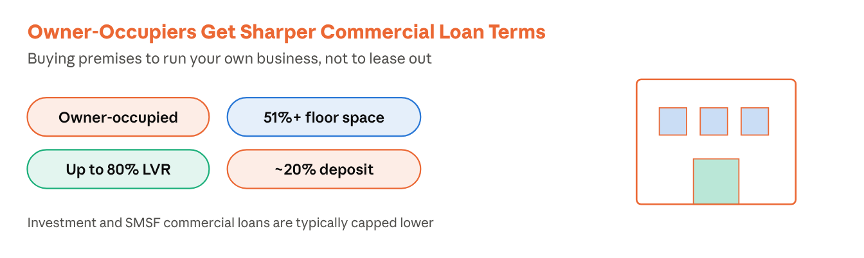
If your business will occupy the building, lenders treat the loan very differently to a commercial investment purchase. Owner-occupied commercial loans in Australia typically reach up to 80% LVR, against roughly 60 to 70% for a leased investment property, because a tenant who is also the borrower is the most reliable income a lender can underwrite.
What Counts as "Owner-Occupier" Finance?
Most lenders on a broker panel apply a simple test: your own business has to occupy at least 51% of the floor space. Lease the rest to another tenant and the loan can still be assessed as owner-occupied, provided your business remains the majority occupant. Buy it purely to lease out to someone else, and it is assessed as an investment loan instead, at a lower LVR and a higher rate.
How Much Can You Borrow?
Indicative LVRs vary by what you are buying:
- Industrial property (factories, warehouses): up to 80%
- Well-located office: 65 to 75%
- Retail: 65 to 75%
The lender's own valuation sets the ceiling, not your contract price. Pay above valuation and the gap comes out of your deposit.
How Do Lenders Assess the Loan?
Two things are tested, not one. The property is assessed on type, location, condition and how easily it could be resold if the loan defaulted. The business is assessed on cash flow: tax returns, BAS and financial statements, typically up to two years' worth for a full-doc loan, plus time in business, credit history and existing debts. A track record of on-time rent payments on your current premises can support the application.
What Does a Typical Application Look Like in Practice?
Item
Example
Property type
Industrial warehouse, owner-occupied
Purchase price
$1,200,000
Lender valuation
$1,180,000
LVR
80%
Loan amount
$944,000
Deposit required
$256,000
Indicative rate (Oct 2026)
from 6.25% p.a.
The deposit is calculated against the lender's valuation ($1,180,000), not the purchase price, so a contract priced above valuation needs extra cash to bridge the gap.
How Long Is the Loan Term, and What Rate Should You Expect?
Commercial terms typically run 5 to 15 years, occasionally stretching to 25 to 30 years for strong borrowers on strong assets, well short of a 30-year home loan as the default. Facilities are commonly reviewed every one to three years. Owner-occupier rates were starting from around 6.25% p.a. as at October 2026, with investment and SMSF loans priced higher. Variable rates are standard, interest-only periods are available, and some lenders offer fixed terms.
What Should You Check Before You Apply?
- Confirm your business will occupy at least 51% of the floor space, not just "most" of it informally
- Get an independent valuation early. The lender's number, not the contract price, sets your LVR
- Have two years of financials, tax returns and BAS ready before you apply
- Ask whether the facility is reviewed in 1, 2 or 3 years, and what happens at review
- Compare industrial, office and retail LVR caps if you have a choice of asset type
How Is Owner-Occupier Commercial Finance Different From an Investment Loan?
Lenders price and assess owner-occupier commercial loans differently from investment commercial loans, and the gap catches a lot of first-time buyers by surprise. On an investment purchase, the lender's primary comfort is the rental income the property itself generates, assessed against a market rent and a vacancy allowance. On an owner-occupier purchase, there's no external tenant, so the lender is really underwriting your business: its revenue trend, its profitability, and whether it could still service the loan if trading conditions softened.
That shows up in three practical ways. First, serviceability is assessed from your business financials (usually the last two to three years of tax returns and financial statements) rather than a rental appraisal, so a business with thin or volatile profit can struggle to get the same LVR as a business with steady, demonstrable cash flow, even on an identical property. Second, many lenders ask for a notional market rent calculation anyway, essentially "what would this space lease for if you weren't in it", because if your business ever moves out or closes, the property's income-generating capacity on resale matters to the lender's risk view. Third, some lenders offer modestly better pricing on owner-occupier deals than investment deals, on the reasoning that a business occupying its own premises has a strong incentive to keep trading and keep paying the loan, compared with a passive investor who might walk away from an underperforming asset more easily.
What Loan Terms and Rates Should You Expect?
Commercial property loan terms vary more between lenders than home loan terms do, so it pays to compare more than just the headline rate. Loan terms for owner-occupied commercial property typically run 15 to 25 years, somewhat shorter than the 30-year standard for residential lending, and many commercial loans are offered on a principal-and-interest basis from day one, though some lenders will allow an initial interest-only period, commonly one to five years, particularly if the business is using the interest-only period to fund fit-out or early growth.
Rates for commercial property loans generally sit above equivalent residential rates, reflecting the lender's higher risk assessment on business-backed security, though the exact margin varies by lender, loan size, LVR and the strength of the business financials. Fixed and variable options are both commonly available, and some lenders offer a split facility. It's also worth checking whether the loan is assessed under the National Credit Code: many commercial property loans to a business (rather than to an individual for personal use) fall outside the Code, which affects the disclosure and hardship protections that apply, something your broker or lawyer should walk you through before you sign.
What Happens If Your Business Outgrows the Property?
This is one of the more overlooked long-term considerations in an owner-occupier purchase, and worth thinking through before you commit to a specific size and location. If the business grows faster than expected and needs more space, you have broadly three options: lease out part of the property to another tenant if there's spare capacity (which, depending on your loan terms, may change the loan's classification from purely owner-occupied to partly investment, so check with your lender first), sell the property and use the proceeds plus any growth in equity to buy or build something larger, or keep the original property as a passive investment and lease new, larger premises elsewhere for the business to trade from.
Each path has different tax, finance and timing implications, and the right one depends on how much equity you've built, whether the area still suits the business, and whether the business can service two sets of obligations during a transition period. Some buyers deliberately purchase a property with room to expand, or on a site that could later support redevelopment, specifically to avoid this problem, even if it means a larger initial loan and a longer payback period on the extra space.
Where Does This Fit With a Borrowing Capacity Check?
Before you go property hunting, it's worth running your numbers through a borrowing capacity calculation first, since owner-occupier serviceability is assessed against your actual business performance rather than a rental yield, and a rough estimate early can save a lot of wasted time looking at properties outside your realistic range. TransformBiz's commercial finance page covers how we structure these applications, and our Borrowing Capacity calculator on the homepage gives a starting estimate based on your business financials before you go to a lender formally. Treat the result as a planning figure rather than a loan offer: an actual approval depends on full documentation, the specific property, and each lender's current credit policy, which shifts over time with broader lending conditions.
How Much Deposit Should You Actually Plan For?
The 80% LVR ceiling quoted earlier is a maximum, not a default, and most owner-occupier purchases land somewhere below it once a lender has assessed the specific business and property. It's worth budgeting for a deposit closer to 25 to 30% rather than the bare minimum, for a few reasons beyond the headline LVR: lenders often shade the LVR down for a business with a shorter trading history, a property with a more specialised fit-out, or a sole-director company without a long track record, and purchase costs beyond the deposit itself, such as stamp duty (which, unlike most residential purchases, usually cannot be capitalised into a commercial loan the way it sometimes can for a home loan), legal fees, and any fit-out or make-good costs, add up quickly and need to be funded separately from the loan.
Building a small contingency into the deposit budget, rather than stretching to the exact minimum the lender will accept, also gives you more room to negotiate on price and more resilience if settlement costs come in higher than first quoted.
Which Lenders Actually Write These Loans?
The market for owner-occupier commercial lending in Australia spans the major banks, regional banks, and a growing number of non-bank commercial lenders, and the right fit depends more on your business profile than on chasing the lowest headline rate. The major banks generally offer the most competitive pricing for established, profitable businesses with clean financials and a straightforward property, but tend to be slower and more conservative in credit assessment, particularly for newer businesses or less conventional property types. Regional banks and specialist commercial lenders often show more flexibility on serviceability assessment and faster turnaround, sometimes at a modest pricing premium, which can matter if you're under time pressure in a sale process. A commercial finance broker who works across multiple lenders can save considerable time by matching your specific business profile to the lenders most likely to approve quickly and on the best terms, rather than applying to one bank and hoping.
Disclaimer
This article is general information only and does not take into account your personal financial situation. Lending criteria, LVR caps and interest rates vary between lenders and change over time. Speak with TransformBiz's advisory team before making a finance decision based on this content.
Sources:

Written by
Vineet, Founder & Principal Advisor
Founder of TransformBiz with 20+ years across PwC, Deloitte and Protiviti in corporate finance, banking and operations.