
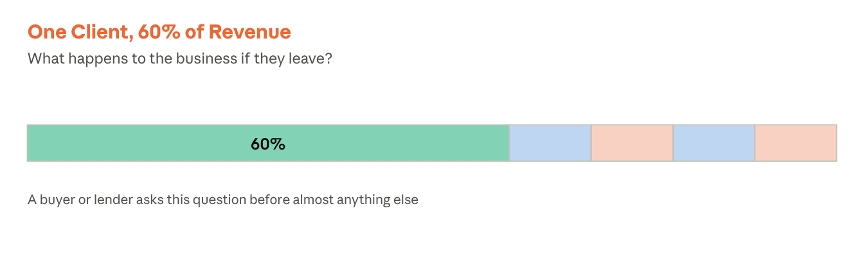
It's the first question a buyer or a lender asks once they see the top line: how much of this revenue sits with one customer, and what happens the day that customer leaves? There's no universal cut-off that makes a concentration level safe or unsafe, but there is a well-worn way of testing it, and it's worth doing before someone else does it to you.
What Is Customer Concentration Risk?
Customer concentration risk is the exposure a business carries when a large share of its revenue depends on one or a small handful of customers, calculated simply as that customer's revenue divided by total revenue. If the relationship ends, the business loses that share of its income at once, not gradually, which is what makes it a different kind of risk to a slow decline in the broader market.
Is There a "Safe" Percentage?
No single percentage marks a safe or unsafe line. A commonly cited reference point is the 10% revenue share used as the disclosure threshold for a major customer under accounting standards, but that threshold exists to flag the information for financial statement users, not to grade risk. A percentage alone does not set a valuation discount, a borrowing limit or a risk grade on its own; the context around it does.
How Does It Affect What a Buyer Will Pay?
A buyer discounts a business more heavily the harder it is to verify that the revenue would survive a change of ownership, and a single dominant customer is one of the clearest reasons a buyer asks that question. The size of the discount depends on the contract terms, the margin earned on that customer, and how replaceable the relationship actually is, not on the raw percentage by itself.
How Does It Affect Whether You Can Borrow Against the Business?
Asset-based lenders often apply a similar logic in practice. Receivables tied to one dominant customer can attract a lower advance rate, or be excluded from the borrowing base altogether, even where there's no specific regulatory threshold forcing that outcome. A lender is asking the same underlying question a buyer asks: what happens to the cash flow backing this facility if that one relationship ends?
What Does a Concentration Review Actually Look At?
- The contract's renewal and termination terms, including notice periods
- The margin earned from the largest customer, and which costs would remain if it left
- Payment timing, and any outstanding balances owed by that customer
- Whether apparently separate customers actually share an owner, an industry, or the same demand driver
- Whether a recent acquisition, a change in reporting period, or a change in how customers are grouped has distorted the comparison
What Can You Do to Reduce the Risk Before You Sell or Borrow?
Scenario
Illustrative revenue
Total annual revenue
$2,000,000
Client A (60%)
$1,200,000
Clients B to E (10% each)
$200,000 each
Revenue left if Client A leaves
$800,000
A $2,000,000 business that loses a 60% client doesn't shrink by 60%, it loses the cash flow it was using to cover fixed costs, rent, staff and loan repayments, while $800,000 a year remains to cover all of it. Build out the rest of the client base before you need to, lock in longer notice periods or contract terms with the dominant customer, know the true margin on that relationship well enough to explain it, and disclose the concentration to a buyer or lender early with a credible plan, rather than let them find it themselves.
How Do Lenders and Buyers Price In Concentration Risk?
Concentration risk doesn't just make a sale harder; it directly affects price and financeability, and it helps to understand the mechanics so you're not negotiating from a position of surprise. Buyers and their advisers typically build concentration risk into the valuation by applying a lower earnings multiple than a comparable, diversified business would command, or by adjusting EBITDA downward to reflect the probability-weighted risk of losing the key client, effectively treating part of that revenue as less certain than the rest of the business's income.
On the lending side, banks financing an acquisition will often look specifically at customer concentration as part of their credit assessment, and a business with one client at 60% of revenue will typically see a lower maximum LVR offered against the deal, a request for the loan to be structured with a shorter term or faster amortisation to reduce exposure sooner, or in some cases a requirement for additional security or a personal guarantee beyond what would be asked for a more diversified business of similar size. Some lenders will also ask for evidence of contract length remaining with the key client and any change-of-control clauses, since a contract that automatically terminates or can be cancelled on a change of ownership materially increases the risk the lender is being asked to carry.
Can You Fix Concentration Risk Before Selling?
Yes, and for a vendor planning an exit, addressing concentration risk ahead of a sale process is one of the more effective ways to protect the multiple you ultimately achieve. The most direct fix is genuine diversification: actively winning new clients over twelve to twenty-four months before a planned sale to bring the largest client's share down, even if the dollar revenue from that client stays the same or grows, because it's the proportion of total revenue that drives the risk perception, not the absolute size of the relationship.
Where diversification isn't realistic in the available timeframe, other steps can still help: locking in a longer-term contract with the key client well before going to market, since a secured multi-year agreement is viewed very differently from a relationship that could end on short notice, removing or softening change-of-control clauses in that contract if possible, so the relationship doesn't automatically become uncertain the moment ownership changes, and building and documenting relationships with multiple contacts inside the key client's organisation rather than relying on a single relationship owned personally by the vendor, since buyer concern is often less about the client leaving and more about the relationship having been personal to the seller rather than institutional to the business. None of these fully eliminate the risk, but each one reduces the discount a buyer or lender will reasonably apply.
What Contractual Protections Help Manage the Risk?
Beyond fixing the underlying exposure before sale, deal structure itself can share or shift concentration risk between buyer and seller rather than leaving it entirely with the buyer. An earnout tied to retention of the key client, where part of the purchase price is only paid if the client relationship continues and performs for an agreed period post-sale, aligns the vendor's final proceeds with the very risk the buyer is most worried about, which can unlock a deal that wouldn't proceed on a straight, fully-paid valuation.
A warranty and indemnity from the vendor specifically addressing the key client relationship, covering matters like undisclosed problems with the relationship, upcoming contract renewal risk, or side arrangements not reflected in the written contract, gives the buyer a legal remedy if something was misrepresented, separate from the earnout's commercial risk-sharing. Some deals also use a holdback, where a portion of the purchase price is held in escrow for a defined period and released once the key client relationship has demonstrably survived the transition, which is a simpler mechanism than a full earnout but achieves a similar protective effect for a shorter, defined window. Which combination makes sense depends heavily on how willing each side is to share the specific risk, and that's usually a negotiation worth running with experienced M&A advisers on both sides rather than a template answer.
How Should You Think About This as a Buyer Rather Than a Seller?
Everything above has largely been framed from the seller's side of managing and disclosing concentration risk, but if you're the one considering buying a business with a dominant client, the same facts support a different set of actions. Rather than walking away outright, it's worth quantifying what you're actually being asked to underwrite: how long has the key relationship existed, is it governed by a written, assignable contract or an informal arrangement, has the client been through a change of supplier before and if so why, and does the relationship depend on the departing owner personally or on the business as an institution.
If the fundamentals check out, concentration risk becomes a negotiating lever rather than a dealbreaker: it supports a lower upfront price, a larger earnout or holdback weighted to retention of that specific client, and warranties specifically addressing the relationship's health. Buyers who do this analysis properly sometimes find a concentrated but well-documented, long-standing relationship is actually a safer bet than a seemingly diversified business where several mid-sized clients are each only a year or two into the relationship and equally capable of leaving.
How Do Buyers Typically Discover Concentration Risk If It Isn't Disclosed Upfront?
Occasionally a seller or their broker understates how concentrated the revenue base really is, whether through optimistic framing or genuine oversight, which makes it worth verifying independently rather than relying solely on the information memorandum. A straightforward check is to request a revenue-by-client breakdown for the past two to three years directly from the accounting system, rather than a summarised percentage figure prepared for the sale, since summarised figures can sometimes average out a concentration that's actually worse in the most recent year than the multi-year average suggests. Cross-referencing the largest invoices or recurring billing entries in the general ledger against the client list is a quick way to confirm the picture matches what's being represented, and it's a check worth doing before, not after, you've committed significant time and advisory cost to a deal.
Disclaimer
This article is general information only and does not take into account your particular business circumstances. How customer concentration affects a valuation or a lending decision depends on the specific business and the specific lender or buyer. Speak with TransformBiz's advisory team for guidance tailored to your situation.
Sources:
##

Written by
Vineet, Founder & Principal Advisor
Founder of TransformBiz with 20+ years across PwC, Deloitte and Protiviti in corporate finance, banking and operations.