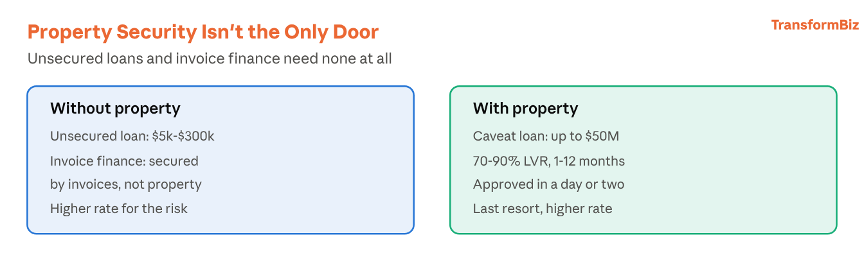
No, not always, but property tends to buy you a cheaper rate and a bigger number when it's on the table. The real question isn't whether you can borrow without it, several products exist specifically because you can, it's what trade-off you're making when you go without.
Is Property Security Always Required?
No. Unsecured business loans, invoice finance and business credit lines are all available without putting up property. Property security is one path among several, not a universal requirement, though it generally unlocks larger amounts and lower rates when it's available.
What Can You Borrow Without Property at All?
Unsecured business loans typically range from around $5,000 to $300,000, with terms from under a year to around five years, and no deposit, security or collateral required. The trade-off is a higher interest rate than a secured equivalent, priced for the extra risk the lender is taking on without an asset behind it.
What Does Invoice Finance Use as Security Instead?
Invoice finance is technically a secured loan, just not secured by property. The unpaid customer invoices themselves are the security, and the lender collects those debts directly, so the amount available is capped by the value of your invoices rather than any property you own.
When Would You Actually Need Property, Like a Caveat Loan?
A caveat loan must be secured by property or land you own, and works like a fast second mortgage, lending 70 to 90% of the property's value, sometimes the full value, from $1,000 up to $50 million, over terms of 1 to 12 months. It's generally treated as a last resort, for when you need funds fast, can repay within the term, and don't qualify for a regular secured or unsecured loan.
What Should You Check Before You Choose Either Path?
- Check whether a regular secured or unsecured business loan would meet your need before considering a caveat loan
- If you do consider a caveat loan, confirm all fees upfront: application, valuation and legal fees are common
- Make sure you can genuinely repay within the term; the property is at risk if you can't
- Compare the all-in cost of invoice finance fees against an unsecured loan's interest rather than assuming either is automatically cheaper
What's the Difference Between a Caveat and a Mortgage?
These are both forms of security but offer very different protection, and lenders price and structure loans differently depending on which one is used. A registered mortgage gives the lender a formal, first-ranking (or specifically ranked) interest in the property, with clearly defined rights to force a sale and recover their debt if you default, and is the strongest form of property security a lender can hold. A caveat is a notice registered on the property's title that alerts anyone searching the title to the caveator's claimed interest, but it doesn't by itself give the same enforceable right to force a sale; it mainly prevents the property being sold or further encumbered without the caveat holder being notified or resolved first.
Because a caveat offers materially weaker protection than a mortgage, caveat loans (sometimes offered by specialist or private lenders) are generally more expensive and shorter-term than mortgage-secured lending, reflecting the lender's greater risk if things go wrong. If you're offering property security, it's worth understanding clearly which form the lender is actually taking, since the protection to you (and the lender's risk, which flows through to your cost) differs significantly between the two.
What Happens to the Security If You Default?
If a loan secured by a mortgage over property goes into default and isn't remedied, the lender has the legal right to take possession and sell the property to recover the outstanding debt, following a formal default and enforcement process that varies somewhat by state but generally includes default notices and a period to rectify before enforcement proceeds. Any surplus after the debt, costs and any other registered interests are paid goes back to you as the property owner; any shortfall, if the sale doesn't cover the full debt, generally remains your personal liability unless the loan was specifically structured as non-recourse, which commercial property security loans rarely are.
If the security is a caveat rather than a mortgage, the practical path to enforcement is less direct, often requiring the caveat holder to take further legal steps to convert their interest into an enforceable claim, which is part of why caveat-secured lending carries a higher risk premium for the lender and, in turn, a higher cost for the borrower.
Can a Guarantor Be Used Instead of Property Security?
Sometimes, though it's not a direct substitute in every case and depends heavily on the lender and the loan's risk profile. A personal guarantee from a director or related party adds the guarantor's personal assets and creditworthiness as additional support for the loan, which can help a marginal application succeed, but most lenders use a guarantee alongside other security or serviceability strength rather than as a complete replacement for property security on a loan that would otherwise need it. For smaller, well-serviced loans with a strong trading history, a personal guarantee alone is sometimes sufficient without property security being required at all.
It's worth treating a personal guarantee with the same seriousness as offering your own property, since a guarantor's personal assets, potentially including their home, can be pursued if the business defaults and the guarantee is called upon, a consequence that's sometimes underestimated by directors signing guarantees as a routine part of getting finance approved.
Is It Ever Worth Offering Security You Don't Have To?
Occasionally, yes, if the trade-off genuinely benefits you. Offering property security when a lender would otherwise approve an unsecured loan, but at a meaningfully higher rate or lower amount, can reduce your overall cost of finance or increase the amount available, provided you're comfortable with the actual risk to that asset if the business underperforms. The calculation is straightforward in principle: weigh the interest rate and borrowing capacity improvement against the real, not theoretical, risk to the asset you'd be securing, factoring in how resilient the business's cash flow genuinely is, not how resilient you hope it will be.
This is a decision worth making deliberately, ideally with input from your accountant or broker on the realistic numbers either way, rather than defaulting to offering security simply because a lender suggests it would help, since the lender's incentive to ask for more security doesn't always align with what's actually in your best interest.
Does the Property Have to Be Business or Could It Be Your Home?
Lenders will often accept either, but using your home carries a different weight of consequence than using a commercial or investment property, and it's worth being clear-eyed about that difference before agreeing to it. Residential property as security for a business loan is common, particularly for smaller businesses without substantial commercial assets, but it directly exposes your family home to business risk in a way that using a separate investment or commercial property doesn't. Some business owners deliberately structure their affairs to keep the family home outside the security pool specifically for this reason, even if it means a smaller loan or a higher rate, treating the separation as a form of risk management rather than purely a finance decision.
How Does This Differ for a Start-Up Versus an Established Business?
Lenders generally ask for more security, proportionally, from a start-up or newly trading business than from one with several years of profitable trading history, because there's less of a track record to assess serviceability against and more uncertainty in the risk being underwritten. An established, profitable business with a strong trading history can sometimes negotiate lower security requirements, or none at all for smaller facilities, purely on the strength of demonstrated cash flow. A start-up, by contrast, should generally expect property security or a personal guarantee to be a near-default requirement for most lenders, regardless of how strong the business plan or forecasts look, simply because forecasts aren't the same evidentiary weight as an actual trading history to a credit assessor.
What Should You Check in the Security Documentation Before Signing?
Beyond understanding caveat versus mortgage in principle, read the actual security documentation for the specific scope of what's being secured (a single asset, or a general security interest capturing more than you expect), whether the security also secures other, unrelated facilities you or a related entity hold with the same lender (a cross-collateralisation arrangement that can trap an asset you intended to keep separate), and what the specific default triggers and cure periods are, since these vary between lenders and matter considerably more once you're relying on them during a genuine cash flow difficulty.
Can Security Requirements Change After Approval but Before Settlement?
Occasionally, if something changes materially between approval and settlement, a valuation comes back lower than expected, the business's financial position shifts, or additional information emerges during final checks, a lender can revise the security or terms they're prepared to offer before funds are actually released. This is part of why it's worth avoiding major financial changes (new debt, large unusual transactions) between formal approval and settlement, and why a longer gap between the two carries slightly more risk of a late change than a shorter, well-managed settlement timeline.
###
Disclaimer
This article is general information only and does not take into account your personal or business circumstances. Lending criteria and pricing vary significantly between lenders and change over time. Speak with TransformBiz's advisory team before applying for finance.
Sources:

Written by
Vineet, Founder & Principal Advisor
Founder of TransformBiz with 20+ years across PwC, Deloitte and Protiviti in corporate finance, banking and operations.