
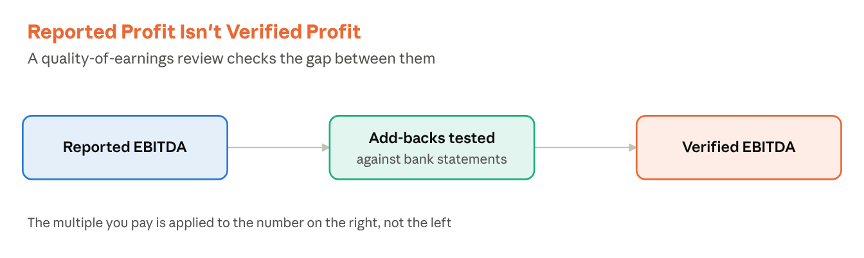
Not at face value, and that's not an accusation, it's how a sale process is supposed to work. The number on a seller's profit and loss statement is a starting point for negotiation, not a verified fact. What turns it into something a buyer can rely on is the testing that happens between first offer and settlement.
What Is a Quality of Earnings Review, and How Is It Different From an Audit?
A quality of earnings review analyses revenue, expenses and profit to test whether reported earnings are sustainable going forward, not just historically accurate. It also looks at how much working capital the business actually needs. An audit mainly confirms that past results comply with accounting standards; a quality of earnings review speaks to what a buyer actually needs in order to make an investment decision.
What Are Add-Backs, and Why Do They Matter So Much?
Add-backs are expenses that won't continue under a new owner, such as above-market owner pay, rent paid to a related party, personal expenses run through the business, or one-off transaction costs. Because valuation is usually a multiple of EBITDA, every dollar added back raises both the earnings figure and the price. That's exactly why they need to be substantiated, not simply asserted.
What Red Flags Should Make You Look Harder?
Accounting errors or departures from standard practice are more common in businesses that have never had an annual audit or review. Add-backs the seller can't substantiate against bank statements, invoices or contracts are another warning sign. And the timing of disclosure matters: a surprise a buyer uncovers themselves during diligence damages trust and can lower the price, delay closing, or end the deal, far more than the same issue disclosed upfront.
###
Who Should Run the Review, the Buyer or the Seller?
Either side can commission one. A seller who runs a sell-side quality of earnings review before going to market can identify and document add-backs themselves, on their own timetable, rather than leaving a buyer's diligence team to find them. That team has little incentive to find adjustments that would increase what their client pays, so an unsubstantiated add-back often simply gets rejected.
What Should You Check Before You Rely on the Seller's Numbers?
- Ask for every add-back to be substantiated against source documents, not just listed
- Check whether the business has ever had an annual audit or review
- Ask how net working capital has moved over the last two to three years
- Treat early, voluntary disclosure of issues as a sign of a trustworthy seller
- Budget time for this properly; a rushed review is how real issues get missed
What Documents Should You Ask For, and in What Order?
A structured request avoids the common trap of accepting whatever the vendor's broker hands over first and assuming it's complete. Start with the full set of financial statements and tax returns for the last three years (not just the most recent, favourable one), management accounts for the current year to date, and the detailed general ledger or trial balance behind the headline P&L, since summarised figures can hide a lot. From there, request the add-back schedule with supporting evidence for each item (not just a list of claimed adjustments), accounts receivable and payable ageing reports, to check how much revenue is genuinely collected versus outstanding, and existing finance and lease agreements, so you understand what debt and ongoing commitments transfer or need refinancing.
It's also worth asking for the business's BAS lodgements for the last two years and comparing the reported GST turnover against the revenue shown in the financial statements the seller has provided for sale purposes. A material, unexplained gap between the two is one of the more reliable early warning signs that the sale numbers have been adjusted more aggressively than the figures lodged with the ATO, and it's a comparison many buyers skip because it requires requesting a document that isn't always offered upfront.
How Do You Verify Numbers Independently of the Seller?
Verification means cross-checking the seller's figures against sources the seller doesn't fully control, rather than just reading what they've prepared. Bank statements are the most direct: reconciling actual deposits against reported revenue over a full twelve-month period (to capture seasonality) will quickly show whether the P&L reflects real cash movement or includes non-cash adjustments that inflate the picture. ATO portal access, where the seller is willing to grant it as part of due diligence, lets you see lodged BAS and income tax figures directly rather than relying on summaries.
Beyond the numbers themselves, independent verification extends to the assumptions behind them: contacting key customers (with the vendor's cooperation, usually late in the process to avoid unsettling relationships prematurely) to confirm contract terms and satisfaction, checking supplier terms and any undisclosed rebates or volume discounts that might not continue under new ownership, and, for businesses with inventory, a physical stocktake rather than accepting the balance sheet figure as accurate. None of this is about assuming bad faith on the vendor's part; even an honest, well-run business can have figures that look different once independently reconstructed, and the gap itself is useful information for your valuation and negotiation, regardless of its cause.
What Are Common Add-Back Abuses to Watch For?
Add-backs exist for a legitimate reason: to show a buyer what the business would earn under new, arm's-length ownership, stripping out the owner's personal and discretionary spending that ran through the business. The abuse starts when add-backs go beyond that purpose. Watch for: personal expenses reclassified as business costs without clear documentation (travel, vehicles, family members on payroll who didn't genuinely work in the business), one-off costs added back as if they're truly non-recurring when the pattern over several years suggests otherwise (a "one-off" repair or legal cost that shows up in multiple years is not one-off), owner's salary added back entirely without replacing it with a market-rate cost for whoever will actually run the business after settlement, which understates the true ongoing cost base, and revenue timing adjustments that shift income into the measurement period from adjacent periods, inflating the figure used for the valuation multiple.
A reasonable rule of thumb: ask for evidence, not just a label, for every add-back over a modest materiality threshold, and ask what the business would look like, and cost to run, with a professional, arm's-length manager in the owner's seat rather than the vendor, since that's closer to the business you're actually buying.
When Should You Bring in a Forensic Accountant?
For most owner-operator business purchases under a few million dollars, a good accountant doing thorough quality-of-earnings style diligence is proportionate and sufficient. A forensic accountant, with specific training in detecting manipulated or misrepresented figures, becomes worth the additional cost in a narrower set of circumstances: when the numbers don't reconcile cleanly despite repeated requests for clarification and the gap is material relative to the purchase price, when the business is cash-intensive (hospitality, some retail, services with high cash components) where revenue is inherently harder to verify through normal document review, when you have a specific, concrete reason for suspicion, such as a BAS-to-P&L gap that the vendor can't satisfactorily explain, or when the deal size is large enough that the cost of a forensic review is small relative to what's at stake if the figures turn out to be wrong.
Raising the idea of a forensic review partway through due diligence can itself be informative: a vendor confident in their numbers will generally accommodate reasonable additional scrutiny, while strong resistance to a proportionate request is, on its own, useful information worth weighing alongside everything else you've found.
How Long Should Due Diligence Realistically Take?
Timeframes vary with deal size and complexity, but rushing this stage to meet a vendor's preferred settlement date is one of the more common regrets buyers report after a deal closes badly. For a smaller owner-operator business (under roughly $2 million in purchase price), four to eight weeks of focused due diligence is a reasonable planning assumption once full documentation has been provided, covering financial verification, legal review of contracts and leases, and basic operational checks. Larger or more complex businesses, particularly those with multiple locations, more complex ownership structures, or industry-specific regulatory considerations, can reasonably take two to three months or more.
A vendor pushing hard for an unusually fast settlement, especially one that doesn't allow time for bank statement reconciliation across a full seasonal cycle or for key customer conversations to happen properly, is worth treating as information in itself. Genuine time pressure sometimes has an innocent explanation (the vendor's own settlement on another property, a planned retirement date), but it's reasonable to ask directly why the timeline is tight and to resist compressing diligence below what the deal size and complexity actually warrant.
What Role Does the Purchase Agreement Play in Protecting You?
Due diligence findings only protect you if they're reflected in the legal contract, not just noted in an email or a due diligence report that sits in a drawer after settlement. Material issues uncovered during the process, whether they're add-back concerns, customer contract risks, or undisclosed liabilities, should translate into specific warranties from the seller, price adjustments, or conditions precedent that must be satisfied before settlement proceeds. A warranty and indemnity clause gives you a direct legal remedy if something the seller represented as true turns out to be false, which is meaningfully stronger protection than a verbal assurance or an informal exchange of emails during negotiations.
Working with a lawyer experienced in business sale transactions, rather than a general commercial lawyer doing an occasional business sale, tends to produce a more robust contract precisely because they've seen which clauses matter in practice when a dispute arises after settlement, not just which clauses look complete on paper.
Disclaimer
This article is general information only and does not constitute financial, legal or accounting advice. Every business sale and its financials are different. Speak with TransformBiz's advisory team before relying on a seller's reported figures in a purchase decision.
Sources:
##

Written by
Vineet, Founder & Principal Advisor
Founder of TransformBiz with 20+ years across PwC, Deloitte and Protiviti in corporate finance, banking and operations.