
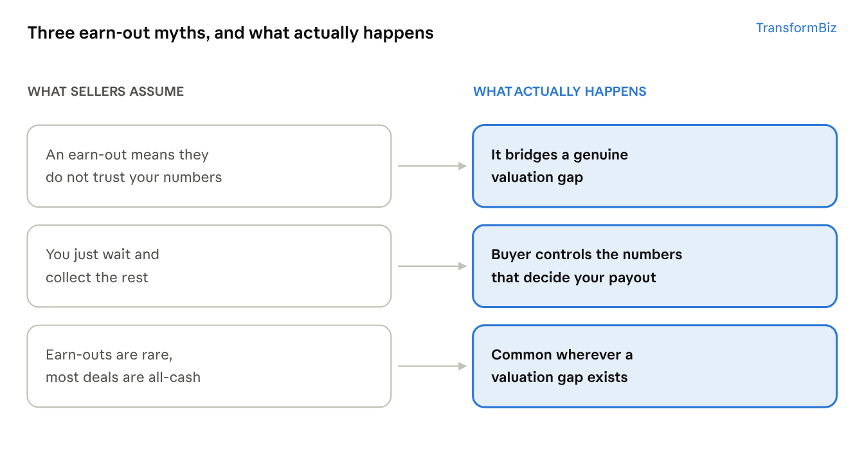
Sellers hear it from other business owners before they ever see a term sheet: if the buyer wants an earn-out, it is because they do not trust your numbers. It is one of the most repeated lines in Australian business sale conversations, and it is wrong often enough that taking it at face value can talk you out of a structure that might actually suit you.
Myth: An Earn-Out Means the Buyer Does Not Trust You An earn-out usually exists because the buyer and seller have landed on genuinely different valuations, not because either side thinks the other is lying. Earn-outs are a recognised way of bridging that gap: if earnings decrease after completion, an earn-out lets the buyer allocate some of that downside back to the seller, rather than the buyer simply refusing to pay the higher price at all. Our earlier explainer on earn-outs covers the full mechanics, the short version here is that it is a bridge, not an accusation.
Myth: You Just Wait Around and Collect the Rest This is the one worth pushing back on hardest. Once completion happens, the buyer usually controls the business, which means the buyer usually controls the numbers your earn-out is measured against. This is not a hypothetical risk, it has played out in Australian courts. In one case, a buyer changed how the acquired business's revenue agreement with a key customer was structured after completion, which reduced the earnings the earn-out was calculated on, and the resulting dispute went all the way through the NSW Supreme Court. In a separate matter, a drafting dispute over whether an earn-out used annual or average annual EBIT nearly doubled the amount owed before the court corrected it. An earn-out is not passive income, it is a second negotiation that happens after you have already handed over the keys.
Myth: Earn-Outs Are Rare, Most Deals Are Straight Cash They show up wherever there is a genuine valuation gap, which in practice covers most deals involving a founder-led business, a recent growth spurt the buyer is not yet willing to pay full price for, or a sector where buyers price on forward numbers they cannot fully verify at completion. If your deal has any of those features, expect an earn-out conversation, planning for it beats being surprised by it partway through negotiations.
So When Should You Actually Push Back? Three situations are worth real resistance, not just a lawyer's redline.
- The metric is something the buyer controls after completion. EBITDA calculated under the buyer's post-sale accounting policies is a different number to EBITDA under yours, and you will not be in the room when those policies get set.
- There is no protection against the buyer running the business down. Without covenants restricting changes to pricing, staffing, suppliers or structure during the earn-out period, a buyer can quietly under-invest in your old division for 12 to 24 months and still be within their legal rights.
- There is no acceleration clause. If the buyer sells the business, changes control, or dismisses you without cause during the earn-out period, a well-drafted agreement should trigger an accelerated or deemed maximum payment rather than leaving your money tied to an owner you never agreed to deal with.
A Worked Example: How a Vague Metric Definition Costs Real Money Picture a $3 million sale with a $500,000 earn-out tied to EBITDA over the following 12 months, with no locked accounting policy. After completion, the new owner centralises payroll processing, finance and insurance through group services and allocates a management fee back to the acquired business. None of this changes how the business actually performs for customers, it is bookkeeping, but it can reduce reported EBITDA by a meaningful margin. The seller is left disputing an accounting allocation they have no visibility into and no contractual right to challenge, because the agreement never defined which costs could and could not be allocated this way.
This is close to the pattern that has shown up in real Australian disputes, where the mechanism for calculating the earn-out, not the underlying business performance, became the actual fight. The fix costs nothing at signing: lock the accounting policy, list excluded costs (management fees, related-party allocations, one-off restructuring charges) explicitly, and agree who audits the number. Should You Ever Walk Away From a Deal Over Earn-Out Terms?
Sometimes, yes. If the earn-out represents a large share of your total consideration, more than roughly a third, and the buyer refuses any of the three protections above (locked metric, operating covenants, acceleration clause), you are being asked to take buyer-controlled risk without buyer-controlled upside. That is a worse position than simply accepting a lower upfront price with no earn-out at all.
A useful test: would you be comfortable if the earn-out were replaced entirely by a lower guaranteed price, say 80 per cent of the earn-out's expected value, paid in cash at completion? If the answer is yes, you are pricing in real doubt about collectability, and that doubt is worth raising directly with the buyer rather than hoping the earn-out resolves in your favour. Buyers who are confident in the deal's prospects and dealing in good faith rarely object to reasonable protections, resistance to basic safeguards is itself useful information about how the rest of the relationship will go.
What Should You Actually Do Before Signing?
Three things, in order. First, get your own accountant, not the lawyer handling the conveyancing paperwork, to model the earn-out metric under a range of post-completion scenarios, including ones where the buyer makes legitimate but unfavourable-to-you operational changes. If the modelling shows the number swings wildly based on decisions you will not control, that is the signal to renegotiate the mechanism before you negotiate the price.
Second, push the operating covenants and accounting policy into the sale agreement itself, not a side letter or a verbal understanding. Side letters are difficult to enforce and are the first thing cut under time pressure before signing. Third, ask the buyer directly how they have structured earn-outs in previous acquisitions, and if they have done this before, ask for a reference from a previous seller. A buyer with a track record of fair earn-out administration will usually be happy to point you to one. A buyer who hesitates is telling you something, even if they never say it out loud.
How Does an Earn-Out Interact With Warranties and Indemnities? An earn-out does not replace the warranty and indemnity protections you would otherwise negotiate, and buyers sometimes try to use the existence of an earn-out as leverage to water down warranty cover, arguing the seller already has skin in the game. Treat this as a separate negotiation. If anything, an earn-out increases the importance of a clean warranty set, because a breach claim against you could be set off against earn-out payments still owed, effectively letting the buyer claw back consideration through a side door. Make sure the sale agreement is explicit about whether, and how, indemnity claims can be set off against earn-out payments, rather than leaving it ambiguous. Sellers who assume the two are unrelated often find out otherwise only when a dispute is already underway, at which point the ambiguity works against whoever has the weaker negotiating position at that moment, usually the seller who has already moved on to their next venture.
What If the Buyer Is a Private Equity Firm Rather Than a Strategic Trade Buyer? Private equity buyers structure earn-outs differently to strategic trade buyers, and it is worth knowing which one you are dealing with before you negotiate. A PE firm is typically building toward its own future exit, often three to five years out, and will manage the acquired business with that horizon in mind rather than full integration into an existing operation. This can cut either way for a seller on an earn-out: a PE owner has less incentive to deliberately suppress short-term earnings through aggressive consolidation, since inflated near-term performance helps its own eventual sale story, but it also tends to run a tighter reporting and governance process that leaves less room for informal give-and-take if a dispute arises. A strategic trade buyer, by contrast, is more likely to fold your business into existing systems, shared services, and a group chart of accounts, which is exactly where the cost-allocation disputes described above tend to originate. Ask directly how the buyer intends to run the business post-completion, standalone, folded into an existing division, or managed toward a future sale, and tailor which protections matter most accordingly. A PE buyer will usually understand and accept locked accounting policies without much pushback, since they want clean numbers for their own eventual buyer too.
Frequently Asked Questions
If a buyer proposes an earn-out, does that mean they think my numbers are wrong?
Not necessarily. An earn-out is most often a way of bridging a genuine difference in how the buyer and seller value the business, allocating some of the risk of future performance to the seller rather than the buyer simply declining to pay a higher upfront price.
Can a buyer legally reduce my earn-out by changing how the business is run after completion?
It depends entirely on what the sale agreement allows. Without operating covenants restricting pricing, staffing, supplier and structural changes during the earn-out period, a buyer's legitimate post-completion decisions can still reduce the measured earnings, and Australian courts have upheld outcomes exactly like this where the agreement did not prevent it. What happens to my earn-out if the buyer sells the business again during the earn-out period? Unless the agreement includes an acceleration clause or a deemed maximum payment trigger, you could be left owed money by an owner you never negotiated with and have no relationship to. This is one of the first protections to check for before signing.
How are earn-out disputes usually resolved in Australia?
Most sale agreements send an earn-out dispute to an independent accountant or expert acting as an expert determiner, rather than to court, though disputes that turn on contract drafting rather than the earnings calculation itself can and do end up in court. Can I get insurance or other protection against an earn-out dispute? Warranty and indemnity insurance typically does not cover earn-out disputes themselves, since an earn-out shortfall is not a breach of warranty, it is a commercial outcome. Your main protection is getting the mechanism right in the sale agreement before signing, not insuring against it afterwards.
How common are earn-outs in Australian SME M&A deals?
Common enough that most business owners selling a founder-led company should expect the conversation. They show up most often where there is a genuine valuation gap, a recent growth spurt the buyer has not yet priced in, or a business whose forward performance the buyer cannot fully verify at completion. Sources
- Earn-outs in M&A: pitfalls and remedies, Baker McKenzie
- What's market: earn-outs in Australian M&A, Clifford Chance
- Earn-outs and contingent consideration: lessons from recent court cases, Herbert Smith Freehills
- Earn-Outs and Deferred Payments in a Business Sale, Astris Law
As of 18 November 2026.

Written by
Vineet, Founder & Principal Advisor
Founder of TransformBiz with 20+ years across PwC, Deloitte and Protiviti in corporate finance, banking and operations.
Try it yourself
Deal Analysis Engine
Price a business you want to buy or sell — or health-check your own — with the same underwriting lens we use on real deals.