
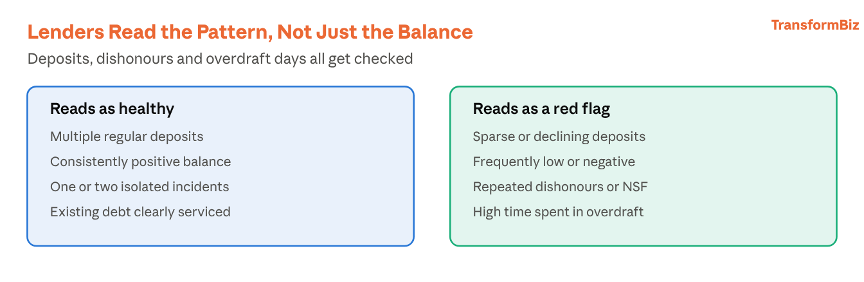
More than most applicants expect. A lender isn't just checking that money is there, it's reading the pattern of how it moves, and that pattern can matter as much as the number on the final line.
Why Do Lenders Even Look at Bank Statements?
Statements let a lender verify revenue and cash flow stability directly, rather than relying only on what you report. Non-bank lenders typically ask for six to twelve months of statements, while major banks usually pair them with full financial statements, business plans and cash flow projections.
What Period Do Lenders Actually Review?
Commonly three to six months, and longer for a seasonal business, so the pattern reflects a full trading cycle rather than just its quiet or busy part. Most lenders now pull this data electronically, through open banking or a provider such as illion, as a read-only copy rather than a document you upload yourself.
What Counts as a "Clean" Trading Pattern?
Multiple, regular deposits from several customers, a consistently positive average daily balance, and recurring payments that look like normal trading rather than one-off transfers. Statements should clearly show the trading name, come from a legitimate Australian bank, and have no missing or altered pages, since partial statements are treated as a red flag in themselves.
What Actually Hurts an Application?
Sparse or declining deposits, a consistently low or negative balance, and dishonoured payments or unauthorised overdraft fees, especially if they happen repeatedly rather than once or twice. Lenders also look at what percentage of days the account spends in overdraft, not just whether it happens at all.
What Should You Check Before You Submit Your Statements?
- Make sure every page is included and nothing is missing or altered
- Confirm the trading name and bank are clearly visible on each page
- Be ready to explain any unusual deposits, gaps, or lump sums
- Know your own NSF, dishonour and overdraft history before the lender finds it first
- Never alter a statement; it's illegal and can get you blacklisted from borrowing
How Far Back Do Lenders Look?
Most lenders request between three and six months of business bank statements as standard, though this can extend further, sometimes to twelve months, for a larger loan, a more marginal application, or if the initial statements raise questions the lender wants more history to resolve. Lenders are generally looking for a representative period of normal trading, which is one reason seasonal businesses should be prepared to explain any months that look unusually strong or weak relative to the rest of the year, since an assessor unfamiliar with your industry's seasonality may otherwise misread a normal low season as a concerning trend.
It's worth reviewing your own statements for the period a lender is likely to request before you apply, specifically looking for the issues covered below, rather than being surprised by what the lender flags during assessment.
What About Gambling Transactions or Buy-Now-Pay-Later?
These two categories draw specific attention from lenders' statement-reading systems and assessors, more so than general discretionary spending. Regular or large gambling transactions through a business account, even if the business itself isn't gambling-related, raise direct concerns about cash flow management and the owner's financial discipline, and can be difficult to explain away convincingly if they appear repeatedly. Frequent buy-now-pay-later activity is a newer but increasingly scrutinised signal, since it can indicate reliance on short-term credit to manage cash flow gaps that a healthier business wouldn't need.
Neither is necessarily disqualifying on its own, particularly if it's limited and clearly separate from the core trading activity the lender is assessing, but a pattern of either, especially combined with other conduct flags like low balances or frequent near-overdraft positions, compounds the overall risk picture a lender forms rather than being assessed in isolation.
Can You Fix Conduct Issues Before Applying?
Yes, and giving yourself time to do so before applying is one of the more effective, controllable things you can do to improve an application. Because lenders typically look at a recent, fixed window of statements, a sustained period of cleaner conduct, no dishonours, reduced or eliminated gambling and buy-now-pay-later activity, more consistent balances, directly changes what the lender sees when they pull your statements for that window. Three to six months of demonstrably cleaner conduct before applying is a realistic, achievable timeframe for most businesses willing to make the changes.
It's worth being honest with yourself about what's driving any conduct issues in the first place. If dishonours are happening because the business genuinely can't cover its outgoings reliably, fixing the symptom (tidying up statements) without addressing the underlying cash flow problem just delays the same issue resurfacing, whether with this lender or the next one.
Do All Lenders Weight Conduct the Same Way?
No, and this is worth knowing before you assume a conduct issue rules out finance altogether. Major banks generally apply the most conservative view of bank statement conduct, with less flexibility to look past dishonours or erratic balances even if the underlying business is otherwise sound. Non-bank and specialist commercial lenders often take a more holistic view, weighing conduct alongside other factors like trading history, industry, and the specific reason behind any issues, rather than treating a dishonour or two as an automatic decline trigger.
This difference in approach is one of the clearer reasons a broker who knows which lenders are genuinely more flexible on conduct, rather than technically "non-bank" but equally conservative, can make a material difference to whether an application with some conduct history succeeds, and on what terms.
What If the Issues Were a Genuine One-Off?
Lenders do distinguish between an isolated incident with a clear, documented explanation and an ongoing pattern, but the burden is on you to make that distinction clear rather than assuming the lender will infer it. A single dishonour caused by a specific, explainable event (a client paid late, a one-off administrative error) accompanied by a short written explanation and evidence it hasn't recurred is viewed very differently from the same dishonour sitting unexplained among several others. Proactively addressing an obvious one-off in your application, rather than waiting for the lender to ask, generally produces a better outcome than hoping it goes unnoticed.
What's a Realistic Timeframe to Clean Up Conduct Before You Need the Loan?
If you know a finance need is coming, whether a lease renewal, an equipment upgrade, or a property purchase, the ideal approach is reviewing your bank statement conduct at least six months ahead, giving yourself time to address issues before they're the specific window a lender will assess. If the need is more immediate and six months isn't realistic, even three months of deliberately cleaner conduct is better than none, and it's worth being upfront with a broker about the timeline pressure so they can match you to a lender whose assessment window and risk appetite best fit what you can realistically show by the time you need to apply.
Should You Use a Separate Account for Discretionary Spending?
Many brokers and accountants recommend keeping genuinely discretionary or personal-adjacent spending in a separate account from the core trading account a lender will review, not to hide anything, since full disclosure is still expected, but to keep the trading account itself a clean, representative picture of the business's actual operating cash flow. A trading account cluttered with a mix of legitimate business activity and personal or discretionary transactions is simply harder for an assessor to read clearly, even when nothing on it is actually a problem.
Does a Broker See the Same Statements the Lender Will?
A good broker will generally ask to review your statements before submitting an application specifically so they can flag likely conduct concerns in advance, rather than you finding out only once a lender has already assessed and declined. This pre-check is one of the more underused parts of working with a broker: treating the relationship as purely administrative (filling in forms and submitting to lenders) misses the value of having someone look at your statements with a credit assessor's eye before the lender does, when there's still time to address what they find.
Is It Worth Explaining Seasonal Dips Proactively?
If your business has a predictable quiet period, retail around certain months, tourism-linked trades, agriculture tied to harvest cycles, it's worth proactively flagging this in your application rather than letting an assessor unfamiliar with your industry misread a normal seasonal dip as a concerning trend. A short note alongside twelve months of statements (long enough to show the full cycle), explaining which months are typically quieter and why, generally reads far better to a credit assessor than silence, which can otherwise read as either an oversight or something being avoided.
###
Disclaimer
This article is general information only and does not take into account your personal or business circumstances. How a specific lender weighs bank statement conduct varies. Speak with TransformBiz's advisory team before relying on this content for a loan application.
Sources:

Written by
Vineet, Founder & Principal Advisor
Founder of TransformBiz with 20+ years across PwC, Deloitte and Protiviti in corporate finance, banking and operations.