Yes, but the lender still needs to see something. A low-doc loan removes the requirement for full tax returns, financial statements and BAS, it doesn't remove the need for the lender to satisfy itself you can repay. Something else has to fill that gap.
What Is a Low-Doc Loan, and Who Is It For?
A low-doc loan lets you apply without full financial statements, tax returns or BAS. It suits businesses that are profitable in practice but whose paperwork hasn't kept pace, such as sole traders or newer businesses without two full years of lodged financials behind them.
What Do You Provide Instead of Full Financials?
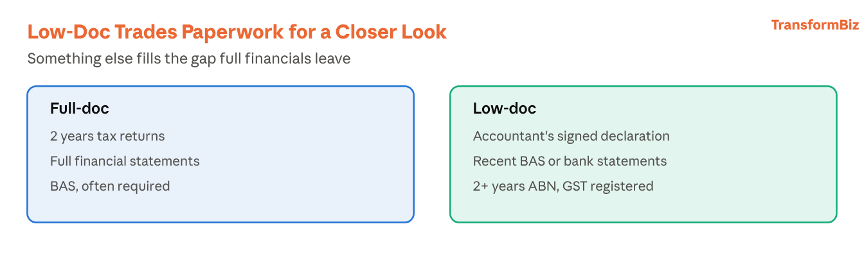
Typically a signed income declaration from your accountant, plus recent BAS or bank statements to support it. Most lenders also want your ABN held for at least two years and current GST registration, and some ask for an asset and liability statement on top of that.
Does a Low-Doc Loan Cost More?
Not always. Low-doc lending is generally seen as slightly riskier by lenders, but a good credit history or a deposit can still get you a competitive rate. It's worth actually comparing offers rather than assuming a low-doc loan automatically costs more than a full-doc one.
What Extra Security Might a Lender Ask For?
Some lenders ask for a deposit of around 20%, or for the loan to be secured against an owned or mortgaged property, to offset the fact that they're not seeing full financials. Not every lender asks for this, so it's worth checking upfront rather than assuming the worst.
How Does a Low-Doc Application Actually Compare to Full-Doc?
Requirement
Full-doc
Low-doc
Tax returns and financials
2 years, typically
Not required
BAS
Often required
Recent BAS or bank statements accepted
Accountant's declaration
Not usually needed
Usually required, signed
ABN and GST history
Varies by lender
Typically 2+ years ABN, GST registered
Extra security
Varies by loan size
May require a 20% deposit or property
What Should You Check Before You Apply for a Low-Doc Loan?
- Confirm your ABN and GST registration meet the lender's minimum history requirement
- Have your accountant ready to sign an income declaration before you apply
- Ask directly whether a deposit or property security will be required
- Compare rates across more than one lender rather than assuming low-doc automatically means expensive
What Documents Do You Still Need to Provide?
"Low-doc" doesn't mean no documentation, and it's a common misconception that trips up first-time applicants. Instead of full financial statements and two to three years of tax returns, most low-doc lenders will ask for some combination of: a signed income declaration or accountant's letter confirming your business income, recent business bank statements (commonly six to twelve months) to show trading activity and cash flow, an ABN registered for a minimum period (often two years), and evidence of GST registration where applicable. Some lenders also want a basic profit and loss statement, even if unaudited, rather than relying on the income declaration alone.
The documentation bar varies meaningfully between lenders, and it's worth understanding exactly what a specific lender requires before assuming low-doc means minimal paperwork across the board, since what one lender accepts as sufficient evidence another may reject outright.
How Much More Do Low-Doc Loans Cost?
Low-doc loans generally carry a rate premium over equivalent full-doc lending, reflecting the lender's reduced visibility into the true financial position, and the premium varies by lender and the strength of what documentation you can provide. Beyond the headline rate, it's also common to see a lower maximum LVR than an equivalent full-doc loan, meaning a larger deposit is required for the same purchase, and sometimes an additional risk fee or higher establishment cost built into the loan.
The practical way to assess whether a low-doc loan is worth the premium is to compare the total cost against the realistic alternative: if becoming "full-doc eligible" means waiting a year or more for your business to build the required trading history, and you need finance now for a genuine opportunity, the premium may well be worth paying. If the gap to full-doc eligibility is only a few months, it's often cheaper to wait and apply through standard channels instead.
Are Low-Doc Loans Regulated the Same Way as Full-Doc?
It depends on who the loan is for and what it's used for, not simply whether it's labelled low-doc. A loan to a company or trust for business purposes generally sits outside the National Credit Code regardless of documentation level, which affects what disclosure and hardship protections formally apply. A loan to an individual, or one where a meaningful proportion is for personal rather than business use, can trigger National Credit Code coverage even if it's marketed as a low-doc business loan, and responsible lending obligations then apply to the lender regardless of how light the documentation requirements look on the surface.
This distinction matters practically because it affects your rights if something goes wrong, so it's worth asking any lender directly whether a specific loan is regulated under the Code, rather than assuming based on how the product is marketed.
When Should You Avoid a Low-Doc Loan?
Low-doc lending is a legitimate, useful product for the right situation, but it isn't the right tool for every gap in paperwork. It's generally worth avoiding, or at least pausing to reconsider, when the real issue isn't a documentation gap but an underlying serviceability concern you'd be masking rather than solving, when the rate premium would make the business's cash flow genuinely tight rather than comfortably serviceable, or when standard full-doc finance is realistically only a few months away and the cost difference doesn't justify the wait avoided.
It's also worth being cautious of any lender who seems more interested in approving the loan quickly than in understanding whether you can actually service it, since low-doc lending's lighter verification can occasionally attract less scrupulous operators. A broker experienced in low-doc lending, or a conversation with your accountant about your genuine serviceability regardless of what a lender is prepared to approve, is a useful check before committing.
How Do You Choose Between Competing Low-Doc Offers?
With documentation lighter, it's easy to focus purely on the headline rate, but the total cost and terms matter more. Compare the comparison rate (which bundles in fees), the maximum LVR offered against your specific property and business profile, any ongoing or exit fees, and whether the loan is principal-and-interest or allows an interest-only period that suits your cash flow plans. It's also worth asking directly what documentation triggers a lower rate tier, since some lenders offer a reduced "low-doc" rate for slightly more documentation than their bare minimum, which can be worth providing if it's readily available and meaningfully improves pricing.
Can a Low-Doc Loan Convert to a Full-Doc Loan Later?
Yes, and for many businesses this is the intended path rather than staying on low-doc terms indefinitely. Once your business has built the trading history and documentation a full-doc lender requires, typically two full years of financials and tax returns, refinancing out of a low-doc facility into standard commercial lending usually reduces your interest rate and can improve your LVR, assuming the business's financial position has remained sound or improved in the meantime.
It's worth building this refinance into your original plan rather than treating the low-doc loan as a permanent arrangement, since the rate premium that made sense as a bridge while you lacked full documentation becomes an unnecessary ongoing cost once you qualify for standard terms. Setting a calendar reminder for when your business will likely meet full-doc criteria, and starting that conversation with a broker a few months ahead of that date, is a simple step many borrowers skip.
How Does a Low-Doc Loan Affect a Future Business Sale or Refinance?
A low-doc loan sitting on your business's books doesn't generally complicate a future sale directly, since the loan is typically repaid or assumed as part of settlement depending on how the sale is structured, but it's worth flagging any low-doc facility to your broker or lawyer early in a sale process so the payout figure and any early repayment costs are factored into settlement calculations from the start, rather than surfacing as a surprise adjustment close to completion.
Do Low-Doc Loans Suit Startups as Well as Established Businesses?
Not equally. Low-doc products are generally designed around businesses that have genuine trading history and income but lack the specific paperwork a full-doc lender wants, commonly because of how an accountant has structured the books for tax purposes, rather than businesses with no meaningful trading history at all. A genuine startup with only a few months of trading will usually struggle to qualify for most low-doc products regardless of how the documentation gap is framed, since the underlying issue isn't a paperwork shortfall but a lack of any track record to assess, and that's a different problem low-doc lending isn't designed to solve.
What's the Realistic Trade-Off Most Borrowers Face?
In practice, the decision usually comes down to weighing a higher rate and lower LVR now against either waiting to become full-doc eligible or walking away from the opportunity the finance was meant to fund. There's no universally right answer; a time-sensitive opportunity (a lease renewal with a deadline, a supplier offering a bulk discount, a property that won't wait) can easily justify the low-doc premium, while a purchase that could just as easily happen in six months once you qualify for standard terms often doesn't need the extra cost at all. Running both scenarios with real numbers, rather than deciding on instinct, is worth the hour it takes with a broker or accountant.
This article is general information only and does not take into account your personal or business circumstances. Low-doc lending criteria and pricing vary significantly between lenders. Speak with TransformBiz's advisory team before applying.
Sources:

Written by
Vineet, Founder & Principal Advisor
Founder of TransformBiz with 20+ years across PwC, Deloitte and Protiviti in corporate finance, banking and operations.