
What Does "Serviceability" Actually Mean?
Serviceability is a lender's test of whether you can meet loan repayments without financial hardship, a requirement under the Consumer Credit Code. Lenders typically cap it so repayments sit under around a third of gross income, with a maximum debt service ratio commonly set at 30 to 35%, and most add a buffer of roughly 2.5 percentage points or more above the actual rate when they test it.
Why Does a Lender Average Two Years, Not Take Your Best Year?
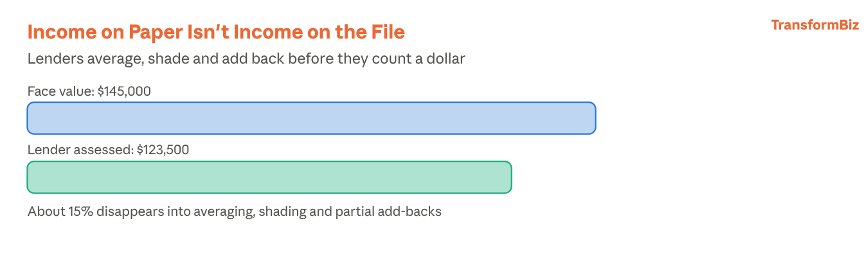
Lenders typically average two years of net income, or use the lower of the two, because they're testing for a sustainable, repeatable number rather than a single strong year. On net income of $90,000 and $110,000 across two years, most lenders would use around $100,000, some the lower $90,000, and only a few the higher $110,000.
What Gets Added Back, and What Doesn't?
Some lenders add back depreciation, genuine one-off expenses and home office costs to your assessed income, and some assess income from your BAS turnover rather than your tax return, which can show a higher figure. No lender adds back every deduction, so your assessed income can end up noticeably lower than what the business actually earned, especially in a year where you've maximised deductions to reduce tax.
Why Does Overtime, Rental or Variable Income Get Shaded?
Because it's less certain to continue. Rental income is commonly counted at around 80% of its actual value, overtime is counted in full mainly in roles like police, fire services or nursing where it's structurally part of the job, and a second job generally needs to have been held continuously for at least a year before it counts at all.
What Should You Do If Your Assessed Income Looks Too Low?
- Ask the lender exactly how they calculated it, including which year's figures and which add-backs they used
- Compare more than one lender's policy; averaging and shading approaches genuinely differ
- Talk to your accountant before tax time about the trade-off between minimising tax and maximising borrowing power, since a deduction that lowers taxable income can cost far more in borrowing capacity than the deduction itself saves in tax
- Keep records that make any add-back easy to substantiate, rather than asserted after the fact
What Counts as Genuine Savings or Additional Income?
Lenders distinguish between income they'll count reliably and income they'll discount or exclude entirely, and understanding this distinction helps explain gaps between what you earn and what a lender assesses. Base salary or regular, consistent business trading income is generally counted close to face value. Overtime, bonuses, and commission income are usually only partially counted, commonly at 80% or less, and often only if there's a demonstrated history (frequently two years) of consistently receiving it, since a one-off bonus isn't reliable future income from a lender's risk perspective.
Rental income from investment properties is typically shaded down too, commonly to around 70 to 80% of the gross figure, to account for vacancy periods, management fees and maintenance costs the lender assumes will occur even if your actual experience has been better than that. Casual or irregular income, and income from a business with a short trading history, tends to be treated most conservatively of all, sometimes excluded from the serviceability calculation entirely until a longer track record exists.
How Does Existing Debt Affect the Calculation?
Every existing debt commitment reduces the room left for a new loan, and lenders generally assess existing debt more conservatively than you might expect. Credit card limits are usually assessed at their full limit, not your actual balance or usual repayment, on the assumption you could draw the full limit at any time, so an unused $20,000 credit limit still counts against your serviceability as if it were drawn. Other loans, personal, vehicle, or existing business finance, are counted at their actual repayment, but if a loan has an unusually short remaining term, some lenders will recalculate the repayment as if it were on a more standard term, which can increase the assessed commitment rather than reduce it.
This is one of the more actionable areas to address before applying: closing or reducing unused credit card limits, and paying out or consolidating smaller existing debts where it makes financial sense to do so, can meaningfully improve the serviceability calculation without changing your actual income at all.
Can You Improve Your Serviceability Before Applying?
Yes, and a few concrete steps consistently help. Reducing unused credit limits, as above, frees up assessed capacity immediately. Paying down or consolidating higher-repayment debts, particularly short-term personal loans or high minimum-payment credit cards, reduces ongoing commitments the lender counts against you. Building a longer track record of the income type you're relying on, particularly for bonus, commission, or newer business income, moves that income from being partially or fully excluded toward being counted more fully once a consistent history exists.
It's also worth timing applications deliberately where you can. If a lender will only count overtime or bonus income with two years of history and you're eighteen months in, waiting those extra months, if your timeline allows it, can materially change what a lender is willing to lend compared to applying now and being assessed on base income alone.
Why Do Different Lenders Give Different Answers?
Serviceability isn't a single, objective number; it's the output of each lender's own policy settings, and those settings vary meaningfully. Different lenders apply different shading percentages to the same income types, different assumed living expense benchmarks, and different buffer rates (an assumed interest rate higher than the actual rate on offer, used to stress-test whether you could still service the loan if rates rose). Two lenders looking at identical financials can reasonably reach different maximum loan amounts purely because their internal policy settings differ, not because either has made an error.
This is why a decline, or a lower-than-expected offer, from one lender isn't necessarily a reliable indicator of what every lender will say, and why comparing across multiple lenders, ideally with a broker who knows which lenders' policy settings suit your specific income mix, is worth doing before accepting the first answer as the final word.
Does the Type of Business Structure Change How Income Is Assessed?
Yes. A sole trader's serviceability is usually assessed directly from personal tax returns and business schedules. A company director drawing a salary plus dividends or trust distributions faces a more complex assessment, since lenders need to look through to the underlying business performance rather than just the personal income drawn, particularly if income is deliberately kept low for tax purposes while the company retains profit. This is a common mismatch directors run into: strong business performance on paper but modest personal income, which some lenders will look past with full financials and others will assess strictly on personal income alone, making lender choice particularly important for company directors with this profile.
Should You Get a Second Opinion If One Lender's Number Seems Low?
If a lender's maximum offer feels materially out of step with what you believed you could comfortably afford, it's worth getting at least one more serviceability assessment before accepting that figure as a ceiling, particularly given how much policy settings vary between lenders as covered above. A mortgage or commercial finance broker can often run your numbers against several lenders' policies quickly, without multiple formal applications (and the credit enquiries that come with them), through preliminary serviceability calculators or direct conversations with lender BDMs, giving you a realistic sense of the actual range before committing to a full application anywhere.
Does Having Multiple Income Sources Help or Complicate Things?
It can do both. Multiple income sources, a salary plus a side business, or two directors each contributing household income, generally support a stronger combined serviceability position in principle, but each source is individually scrutinised and shaded according to the rules above, and the documentation burden multiplies with each source you're relying on. Being selective about which income sources you actually need to include, rather than listing every possible source and the paperwork that comes with it, can sometimes streamline an application without materially changing the outcome if the core sources already support the loan amount you need.
How Much Does Living Expense Estimation Affect the Outcome?
Lenders assess your likely living expenses using either your declared figures or a benchmark measure (commonly the Household Expenditure Measure), whichever is higher, and this assumed outgoing directly reduces the surplus income available to service a new loan. Declaring unrealistically low living expenses to improve serviceability rarely works, since most lenders will apply the benchmark figure regardless if your declared number looks implausibly low for your household size and circumstances, and an inflated or dishonest declaration can itself raise broader concerns about the application's reliability.
Disclaimer
This article is general information only and does not constitute financial advice. Serviceability policy varies significantly between lenders and changes over time. Speak with TransformBiz's advisory team before relying on this content for a loan application.
Sources:

Written by
Vineet, Founder & Principal Advisor
Founder of TransformBiz with 20+ years across PwC, Deloitte and Protiviti in corporate finance, banking and operations.