
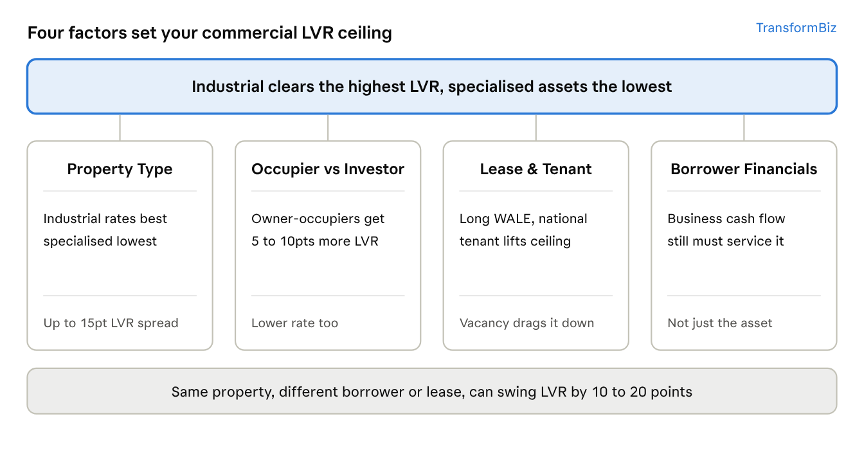
Two businesses can buy an identical warehouse and get offered meaningfully different loan-to-value ratios. There is no single commercial LVR, the number moves on four factors that stack on top of each other, and understanding how they interact is more useful than memorising a single percentage.
Factor One: What Type of Property Is It?
Property type sets the starting range before anything else is considered. Industrial property, warehouses and factories, consistently attracts the sharpest terms because lenders see it as the easiest asset class to value and re-let. Office and retail sit in the middle, more exposed to location and tenant covenant strength. Specialised assets, purpose-built premises like childcare centres, medical facilities or hospitality fitouts, sit at the bottom of the range because a lender has to price in the cost of finding a new tenant or buyer if things go wrong.
Factor Two: Are You Occupying It, or Leasing It Out?
This is the single biggest swing factor after property type. An owner-occupier buying the premises their own business runs from can often reach 70 to 80% LVR, because the lender is underwriting a tenant it already has full visibility into, your business. An investor buying the same property to lease out is underwriting a stranger's tenancy instead, and typically lands 5 to 10 percentage points lower, with a correspondingly higher rate.
Factor Three: How Strong Is the Lease?
For an investment purchase, the lease itself becomes collateral in the lender's eyes. A long Weighted Average Lease Expiry (WALE) with a national tenant on a solid covenant supports a higher LVR than a short lease, an unrated regional tenant, or worst of all, a vacant property with no tenant at all. Vacancy risk is treated conservatively, some lenders will not fund a vacant commercial property at the same LVR as a tenanted one, regardless of how strong the location is.
Factor Four: Can the Borrower Actually Service It?
LVR answers how much the asset supports, not whether you can afford the repayments. For an owner-occupied purchase, the lender assesses the business's own cash flow, income, liabilities and credit history, because the business is the tenant paying the debt. For an investment property, rental income and lease terms carry more weight, but your broader financial position still matters. A property that could technically support 75% LVR on paper will not get there if the borrower cannot service the repayments that come with it.
How the Four Factors Stack
These factors compound rather than operate independently. An owner-occupied industrial property with a financially strong business behind it sits at the top of the range, potentially 80% LVR. The same industrial property bought as an investment, tenanted by an unrated business on a short lease, could land 20 points lower, even though the bricks and the location have not changed at all.
How Do Lenders Actually Value the Property? LVR is only as reliable as the valuation it is calculated against, and commercial valuations are considerably less mechanical than residential ones. A lender-ordered valuer typically uses a capitalisation rate approach for an investment property, dividing net annual rental income by a market cap rate appropriate to the asset type and location, rather than simply comparing recent sales. This means two identical buildings on different leases can receive materially different valuations, because the valuation is partly a valuation of the income stream, not just the bricks.
For owner-occupied property, valuers lean more heavily on direct comparison with recent sales of similar assets, since there is no external tenant income to capitalise. This is one reason owner-occupiers sometimes see a more favourable valuation outcome than an investor would get on the identical building, independent of the LVR percentage itself.
Does the Lender Matter as Much as the Property?
Considerably. Major banks tend to apply more conservative LVR ceilings and more standardised serviceability tests, while specialist commercial and non-bank lenders often price higher LVR or more flexible terms against a higher interest rate and higher fees. A deal that a major bank declines at 65% LVR might be approved by a specialist lender at 70%, at a meaningfully higher cost of funds.
This is why shopping a commercial deal across more than one lender type is worth the extra time, particularly for a specialised asset or a tenant covenant a major bank's credit policy treats conservatively. The right lender for a given deal is not always the one offering the headline-lowest rate, if that rate comes with an LVR ceiling the deal cannot actually clear.
What Can You Do to Improve Your LVR Outcome Before Applying?
Four things move the number in your favour. Strengthen the lease before settlement if you can, a short extension or a rent review locked in ahead of application genuinely changes how a valuer and a credit assessor see the asset. Bring a larger deposit to the table if the numbers are marginal, lenders will often improve pricing, not just approve at a lower LVR, for a meaningfully larger equity contribution. Present clean, recent financials, for an owner-occupied purchase particularly, two to three years of consistent, well-prepared accounts materially outweighs a single strong but unexplained year. Finally, get an independent valuation of your own before you apply, so you are not negotiating from a position of not knowing whether the lender's figure is going to be a problem.
None of this changes the fundamental ceiling set by property type and occupancy status, but within the range that ceiling allows, preparation genuinely moves the outcome.
Cross-Collateralisation: A Factor Investors Should Weigh Separately
Some lenders will offer a higher effective LVR on a new commercial purchase if the loan is cross-collateralised against an existing property the borrower already owns, often a residential property or another commercial asset with equity in it. This is not the same as the LVR on the new purchase improving on its own merits, it is the lender taking security over a second asset to support the first.
This can be a reasonable trade-off for an investor confident in both assets and comfortable with the exposure, but it ties the fortunes of two properties together in a way that is easy to overlook when the immediate goal is simply getting the new purchase across the line. If the new property underperforms, the lender's recourse is not limited to that property alone. Before accepting a cross-collateralised structure to improve your effective LVR, weigh whether unwinding it later, if you want to refinance or sell one of the properties independently, is something the lender will make straightforward or something that becomes its own negotiation.
How Much Does Loan Purpose Change the Picture?
The factors above assume a straightforward purchase. A refinance of an existing commercial property typically gets assessed similarly to a purchase, using current valuation and current lease terms, though a lender may apply a slightly more conservative LVR if the property has not been independently revalued in some years. Construction or development finance for commercial property is a different exercise altogether, LVR is usually replaced or supplemented by a loan-to-cost ratio, and funds are released in stages against completed work rather than as a single drawdown, with the lender's own quantity surveyor monitoring progress. If your deal involves any element of construction, fit-out financing, or a property that will change use, for example converting a warehouse to include a showroom, ask explicitly which ratio and drawdown structure applies before assuming the purchase-
LVR ranges in this article transfer directly, they often do not.
Does GST Affect the Purchase Price and the LVR Calculation?
Most commercial property transactions involving an income-producing property sold with existing tenants qualify for the GST-free supply of a going concern, provided the standard conditions are met, which means GST is not added to the purchase price in the way it would be for new residential property. Where GST does apply, for example a vacant commercial property or one not qualifying as a going concern, the lender generally calculates LVR against the GST-exclusive purchase price or the independent valuation, whichever is lower, rather than the GST-inclusive contract price. This distinction matters for how much deposit you actually need to find, confirm the GST treatment with your accountant before you finalise how much cash the deal requires, rather than assuming the headline contract price is the number your LVR and deposit calculations will actually be based on.
What Role Does a Personal Guarantee Play for a Company Borrower?
When a company, rather than an individual, is the borrower, most commercial lenders will require a personal guarantee from the directors regardless of how strong the LVR and serviceability numbers look on paper. This is standard practice, not a sign the deal is marginal, and it means the four factors in this article determine how much the company can borrow, while the guarantee determines who ultimately carries the risk if the company cannot service the debt.
Some lenders will negotiate a limited or capped guarantee rather than an unlimited one, particularly for a stronger deal with a lower LVR, and this is worth raising explicitly during the application rather than accepting the lender's standard guarantee wording by default. The strength of your LVR position can be a genuine bargaining chip for softer guarantee terms, not just a better rate. Frequently Asked Questions
What is the highest commercial LVR I can realistically get?
Strong owner-occupiers buying quality industrial property can reach up to 80% LVR in the right scenario, though this depends on the lender, the specific asset, and the strength of the business's financials.
Why would an investor get a lower LVR than an owner-occupier on the same property?
Because the lender is assessing different risk. An owner-occupier's own business is the tenant, which the lender already understands. An investor's tenant is a separate business the lender has to assess through the lease terms alone, which is inherently less certain.
Does a vacant commercial property get the same LVR as a tenanted one?
Usually not. Vacancy risk is priced conservatively, and some lenders reduce the available LVR or decline vacant commercial property altogether until a tenant is secured.
Is the LVR calculated on the purchase price or the valuation?
On the lender's own independent valuation, not the contract price. If your purchase price is above the valuation, you need to cover that gap yourself, the LVR percentage will not stretch to meet it.
Does the lender I choose affect my commercial LVR, not just the property? Yes. Major banks tend to apply more conservative LVR ceilings and standardised tests, while specialist and non-bank lenders often approve higher LVR against a higher rate. Comparing lender types, not just rates, is worth the effort on a marginal deal.
What is cross-collateralisation and should I use it to get a higher LVR?
It means securing a new loan against an existing property you own as well as the one you are buying, which can lift the effective LVR a lender will offer. It ties the two properties together, so weigh how it affects your ability to refinance or sell either one independently before accepting it

Written by
Vineet, Founder & Principal Advisor
Founder of TransformBiz with 20+ years across PwC, Deloitte and Protiviti in corporate finance, banking and operations.
Try it yourself
Deal Analysis Engine
Price a business you want to buy or sell — or health-check your own — with the same underwriting lens we use on real deals.