
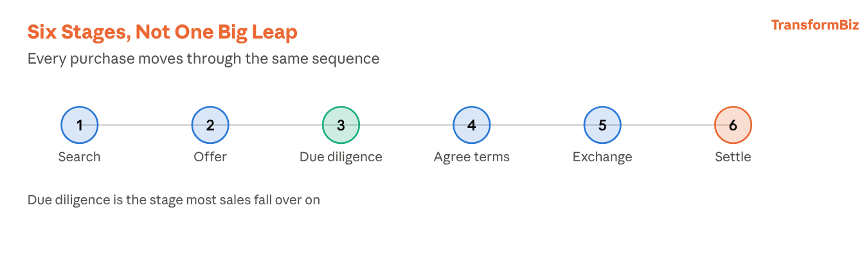
Every business purchase, however different the industry, moves through the same sequence: you search and shortlist, you make an offer, you test it with due diligence, you agree final terms, you exchange contracts, and you settle. What varies is how long each stage takes and how much can go wrong inside it, not the order itself.
What Happens Before You Even Make an Offer?
Before an offer goes anywhere, you assess your own readiness: the finance and skills you can bring, and what kind of business actually fits. From there it's a search and shortlist process, enquiries to sellers or brokers, and a review of the information each one provides, to judge whether a listing is worth pursuing before you put a number on it.
What Does Due Diligence Actually Cover?
Due diligence investigates the business thoroughly before you commit: financial records, legal structure and contracts, customer and supplier relationships, and operational matters that an information memorandum alone won't reveal. It typically runs for two to six weeks, depending on the complexity of the business and how organised its records are.
How Does Negotiation and the Offer Process Work?
An initial offer is usually non-binding and made subject to due diligence. Once key terms are agreed, they're often captured in a Heads of Agreement before the formal sale contract is drafted, giving both sides a working basis to negotiate from without committing to the final document straight away.
What Happens Between Signing and Settlement?
Once contracts are exchanged and a deposit is paid, the period before settlement is used to satisfy any remaining conditions, finalise finance, and prepare for the handover of staff, systems and supplier relationships, so the business can keep running without a gap on day one.
Before any of this starts, line up finance approval or at least a clear sense of what you can borrow, an accountant and a lawyer who can move at the pace a deal needs, and a realistic view of how long due diligence will actually take, so you're not negotiating against your own clock as well as the seller's.
ing a business process
Secondary keywords: how to buy a business Australia, business purchase due diligence steps, business acquisition process checklist
What Usually Goes Wrong at Each Stage?
Knowing where deals typically stumble is often more useful than the process map itself, because it tells you where to slow down rather than where to rush. In the search phase, the most common mistake is chasing a business that looks good on a listing but hasn't been properly screened against your own criteria (budget, skills, location, risk appetite), which wastes months before you discover a mismatch that was obvious from the start. At the offer and negotiation stage, buyers frequently anchor too hard on asking price without first understanding how it was calculated, missing the chance to negotiate on terms (settlement timing, vendor finance, inclusions) that can matter as much as the headline number.
Due diligence is where the most expensive mistakes happen, almost always through rushing it to meet a vendor's preferred timeline or skipping independent verification because the seller "seems honest". At finance and legal documentation stage, buyers underestimate how long bank approval and legal drafting actually take, and get caught trying to compress both into the final fortnight before an agreed settlement date. Settlement itself usually goes smoothly if everything before it was done properly, but a common last-minute issue is discovering a lease assignment, licence transfer, or supplier novation wasn't actioned early enough and now threatens to delay the date.
How Long Does the Whole Process Typically Take?
For a straightforward, smaller owner-operator business, three to six months from first serious look to settlement is a realistic range, assuming the buyer is finance-ready and the business's records are in reasonable order. Larger or more complex acquisitions, those involving multiple locations, more complex structures, or lengthy regulatory or landlord consent requirements, commonly run six to twelve months.
The two stages most likely to blow out a timeline are due diligence (if early findings raise questions that need chasing down) and finance approval (if the lender needs more documentation than first expected, or the deal structure needs revising to get finance across the line). Buyers who build in a realistic contingency on both, rather than assuming everything proceeds on the fastest possible schedule, tend to have a smoother experience and avoid the pressure that leads to cutting corners later in the process.
What Professionals Should Be on Your Team?
A competent team materially improves both the outcome and your own stress levels through the process, and it's worth assembling it before you make an offer, not after. At minimum: a business broker or M&A adviser (if you're not working with one already to find the deal) who understands the sector and can sanity-check valuation and deal structure, an accountant experienced in business acquisitions specifically (not just general tax and compliance work) to lead financial due diligence, a commercial lawyer experienced in business sale transactions to draft and review the purchase agreement, and a finance broker or direct banking relationship to run the funding side in parallel with due diligence rather than starting it afterward.
Depending on the business, you may also need a specialist for a particular risk area: an IP lawyer if the business depends on intellectual property or licensing, an industry-specific consultant for a regulated sector, or a workplace relations specialist if staff transfer is complex. Paying for this team upfront feels like a cost against a deal that might not proceed, but it's small relative to the purchase price and the cost of getting a bad deal wrong.
What Happens in the Weeks After Settlement?
The period immediately after settlement is where a lot of the value you paid for can be won or lost, and it's worth planning for before settlement day rather than figuring it out as you go. Priorities in roughly the first month typically include: formally introducing yourself to key customers and suppliers (ideally with the outgoing owner, if a transition period was agreed), confirming all licences, registrations and insurance are correctly transferred or re-established in your name, reviewing staff arrangements and having the conversations that build confidence in the transition, and setting up your own financial reporting and banking so you have visibility of the business's actual performance from day one rather than relying on the vendor's historical reporting.
A documented, agreed handover plan with the vendor, covering what they'll help with and for how long, prevents the common problem of a vendor who becomes unavailable or disengaged the moment the money clears, just when their knowledge is most useful to you.
How Should You Handle Staff During the Transition?
Staff uncertainty during a sale process is one of the more sensitive parts of the whole timeline, and how it's handled affects both morale and, practically, how much knowledge and goodwill transfers with the business. Under Australian law, employees generally transfer with the business on an asset sale unless specifically excluded, though the mechanics differ for a share sale (where the employing entity doesn't change) versus an asset sale (where employment technically transfers to the new entity, with accrued leave entitlements typically negotiated between buyer and seller as part of the sale price).
Timing of disclosure to staff is a judgement call best made with the vendor and your advisers together: too early risks unsettling the team and losing key people before the deal even completes, too late risks staff hearing about it informally and losing trust in the process. A clear, honest, reasonably timed communication plan, usually once the deal is sufficiently certain to proceed, tends to produce a smoother transition than either extreme.
How Much Should You Budget Beyond the Purchase Price?
Buyers consistently underestimate the costs that sit alongside the headline purchase price, and building a realistic budget upfront avoids a cash squeeze right when the business most needs stability under new ownership. Beyond the price itself, plan for due diligence costs (accounting and legal fees, which scale with deal complexity but are rarely trivial even for a smaller business), stamp duty where applicable to the transaction structure, finance establishment costs, and working capital to fund the business through the transition period, since trading patterns often dip temporarily around a change of ownership even in a healthy business.
A common rule of thumb among brokers and accountants is to budget an additional 10 to 15% on top of the purchase price for these combined costs and a working capital buffer, though the right figure depends heavily on deal size and complexity, and it's worth running your own specific numbers with your accountant rather than relying on a general guide.
Where Does Finance Fit Into the Timeline?
Finance approval shouldn't start after due diligence finishes; the two should run in parallel from early in the process, since bank or broker assessment timelines (often four to eight weeks for a commercial acquisition loan, longer for complex deals) can otherwise become the bottleneck that delays settlement even when everything else is ready. Our commercial finance page covers how we structure acquisition finance applications, and starting that conversation as soon as you have a signed heads of agreement or letter of intent, rather than waiting for due diligence to fully conclude, gives the lender time to work through their own process alongside yours.
Disclaimer
This article is general information only and does not take into account your personal or business circumstances. Every business purchase is different and timing can vary significantly. Speak with TransformBiz's advisory team before acting on this content.
Sources:
##

Written by
Vineet, Founder & Principal Advisor
Founder of TransformBiz with 20+ years across PwC, Deloitte and Protiviti in corporate finance, banking and operations.