
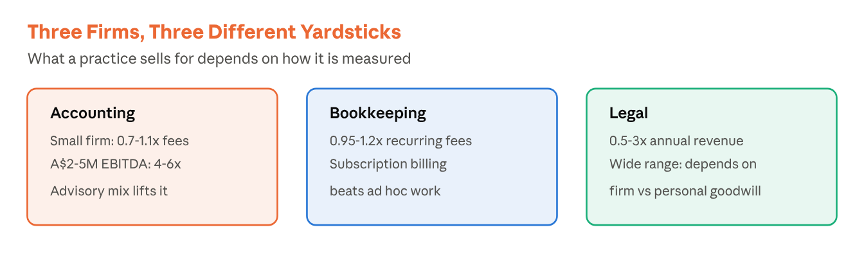
There's no one answer, because there's no one yardstick. Accounting, bookkeeping and legal practices each get priced on a different measure, and the range inside each one is wide enough that the question "what multiple" only makes sense once you know which kind of firm, and which band it sits in.
Why Don't These Firms Sell on the Same Multiple?
Three different buyer bases are pricing three different kinds of risk. An accounting or bookkeeping practice usually prices on recurring fee income, because the client relationships tend to be contracted and repeat annually. A legal practice has historically priced on goodwill that may or may not survive the departure of the named partner, which is exactly why its range is so much wider.
What Does an Accounting Practice Actually Sell For?
By size band in Australia:
- Sub-A$1M in annual fees: 0.70 to 1.10x recurring fees, or 2.5 to 3.5x seller's discretionary earnings
- A$2M to A$5M EBITDA: 4.0 to 6.0x EBITDA
- A$5M to A$15M EBITDA: 5.5 to 7.5x EBITDA
- A$15M to A$50M EBITDA (bolt-on acquisitions): 7.0 to 9.5x EBITDA
- A$50M+ EBITDA (platform scale): 9.0 to 12.0x EBITDA
Separately, sales data tracked by Accountants Daily put regional practices at around 107 cents in the dollar of annual fees and metro practices at around 114 cents, both above the old rule of thumb of dollar-for-dollar parity, with some individual sales reaching as high as 130 cents. At the very top of the market, Count Limited's announced acquisition of Oracle Advisory Group in March 2026 was struck at roughly 8.4x EBITA and 2.7x revenue, a sign of how far multiples stretch once a firm reaches platform scale.
What Does a Bookkeeping Practice Actually Sell For?
Bookkeeping multiples sit close to the small end of the accounting range, typically 0.95 to 1.20x recurring fees for a subscription-style client base. In one real Australian listing, a bookkeeping practice was offered at $1,100,000 against $901,399 in annual revenue and $300,269 in seller's discretionary earnings, implying roughly 1.22x revenue and 3.66x earnings, both comfortably inside the ranges above.
What Does a Legal Practice Actually Sell For?
Legal practice sales are far less standardised in Australia than accounting or bookkeeping. The widely cited international rule of thumb is 0.5 to 3.0x annual gross revenue, averaged over roughly five years, with where a firm lands inside that wide range driven by whether goodwill belongs to the firm's brand or to one named lawyer, how dependent revenue is on repeat clients, and how specialised the practice area is.
What Does a Real Transaction Look Like?
Sector
Typical multiple
Real-world reference
Accounting (sub-A$1M fees)
0.70 to 1.10x recurring fees, or 2.5 to 3.5x SDE
Metro firms ~1.14x fees, regional ~1.07x fees (DMY sales data, Nov 2023)
Accounting (A$2M to A$5M EBITDA)
4.0 to 6.0x EBITDA
Count Limited / Oracle Advisory Group: ~8.4x EBITA, 2.7x revenue, at platform scale
Bookkeeping
0.95 to 1.20x recurring fees
Listed practice: $1,100,000 against $901,399 revenue and $300,269 SDE, about 1.22x revenue, 3.66x SDE
Legal
0.5 to 3.0x annual gross revenue
Australian-specific benchmarks are scarce; treat this as a starting point only
What Actually Moves the Multiple Up or Down?
- Business advisory or virtual CFO work pushes accounting multiples higher, commonly 5.0 to 6.5x EBITDA in the A$2M to A$5M band, well above a compliance-only practice at 3.5 to 4.5x in the same band
- A compliance-heavy, ageing client book with little advisory work sits at the bottom of every range, around 0.65 to 0.80x fees for a small practice
- Recurring, subscription-style billing is worth more than ad hoc work in bookkeeping and accounting alike
- How much the practice depends on one named principal, rather than the brand or the systems, matters across all three sectors, and matters most in law
- Buyer type changes the ceiling: private-equity-backed platforms generally pay the most for scale, while individual practitioners and small regional firms set the price at the smaller end
What Drives the Difference Between a 1x and a 3x Multiple?
The spread between firms selling at the low end and the high end of their typical multiple range usually comes down to a consistent set of factors buyers and brokers point to again and again, rather than randomness in the market. Recurring revenue is the single biggest driver: a firm built on annual compliance work with high client retention commands a materially higher multiple than one reliant on one-off engagements or project-based advisory work, because the buyer is paying for predictable future cash flow, not just last year's billings. Client concentration works the same way here as in any business sale: a book spread across many clients with no single relationship dominating supports a higher multiple than one where a handful of large clients could leave with a departing partner.
Staff and systems depth matters almost as much as the client book itself. A firm where the knowledge and client relationships sit mostly with the selling principal, with thin middle management and few senior staff capable of running client relationships independently, is harder to transition and carries more key-person risk, which pulls the multiple down. A firm with an established second tier of qualified staff, documented processes, and modern practice management and workflow systems is a materially easier, lower-risk integration for a buyer, and that ease shows up directly in price. Growth trend, profitability margin relative to peers, and the proportion of fees from higher-value advisory work versus lower-margin compliance processing round out the main drivers.
How Does Client/Partner Attrition Risk Affect Price?
Buyers in this sector are particularly focused on what happens to the client base once the familiar face at the top of the engagement letter changes, because professional services relationships are personal in a way that's less true in many other industries. The core mitigation most buyers insist on is a transition or lock-in period, commonly twelve to twenty-four months, where the selling principal remains actively involved in client relationships, introduces the new team personally, and is often restricted from approaching those same clients if they leave or are terminated during an earnout period.
Because of this risk, deal structures in accounting, legal and bookkeeping sales lean more heavily on deferred and performance-linked consideration than many other business sale categories. It's common to see 60 to 80% of the headline price paid at completion, with the remainder held back and paid over one to three years, often tied explicitly to client revenue retention targets. A seller with strong institutional relationships across the firm (rather than relationships personally owned by the departing principal) will generally negotiate a higher upfront proportion, because the buyer's attrition risk is genuinely lower, while a firm heavily dependent on one partner's personal relationships should expect, and plan for, a larger deferred component regardless of how the headline multiple looks on paper.
What Deal Structures Are Common for These Sales?
Beyond the upfront and deferred split already described, a few structural patterns show up repeatedly in professional services sales in Australia. An asset sale, where the buyer acquires the client list, work-in-progress, goodwill and equipment rather than the legal entity itself, is common for sole practitioners and small partnerships, partly because it lets the buyer avoid inheriting historical liabilities tied to the old entity. A share or equity sale is more common for larger, incorporated practices, particularly where the buyer wants continuity of existing client engagement letters, trust account authorisations or regulatory registrations that would otherwise need to be re-established under a new entity.
Merger-style deals, where the seller's practice is absorbed into a larger firm in exchange for equity in the combined entity rather than cash, appear more often at the larger end of the market, giving the seller ongoing upside in the merged firm's growth rather than a clean exit. Across all structures, regulatory and professional body considerations add a layer not present in most other business sales: trust account handover requirements, client consent or notification obligations in some professional contexts, and, for legal practices specifically, Law Society or equivalent body requirements around practising certificates and trust money that need to be managed carefully through completion, usually with a specialist business sale lawyer involved alongside the accountant handling the financial side of the deal.
How Do You Get a Realistic Multiple Estimate for Your Own Firm?
Published ranges and rules of thumb are a useful starting orientation, but every firm's actual achievable multiple depends on the specific mix of factors above, applied to its own numbers, not a sector average. The most reliable way to get a realistic figure is an indicative valuation from a business broker or M&A adviser who regularly transacts in professional services, ideally supported by recent comparable sale evidence from the same state and firm size bracket, since multiples can vary noticeably between a Sydney CBD practice and a comparable regional firm.
It's worth getting this indicative figure well before you intend to sell, not in the weeks before going to market, because it gives you time to work on the specific factors that are pulling your own multiple toward the lower end of the range, such as thin management depth or concentrated client relationships, while there's still runway to address them. A firm that starts that work two to three years ahead of an intended sale generally achieves a meaningfully better outcome than one that only assesses its position once a buyer is already at the table.
Disclaimer
This article is general information only and does not constitute a valuation of any specific business. Sale multiples vary with buyer appetite, firm size, client mix and timing. Speak with TransformBiz's advisory team for a valuation tailored to your practice.
Sources:

Written by
Vineet, Founder & Principal Advisor
Founder of TransformBiz with 20+ years across PwC, Deloitte and Protiviti in corporate finance, banking and operations.